ENHANCING CREATIVE THINKING AND LEARNING ACHIEVEMENT IN BIOLOGY THROUGH SCIENCE, TECHNOLOGY, AND SOCIETY (STS) APPROACH FOR GRADE 11 STUDENTS
Keywords:
Creative Thinking, Science Technology and SocietyAbstract
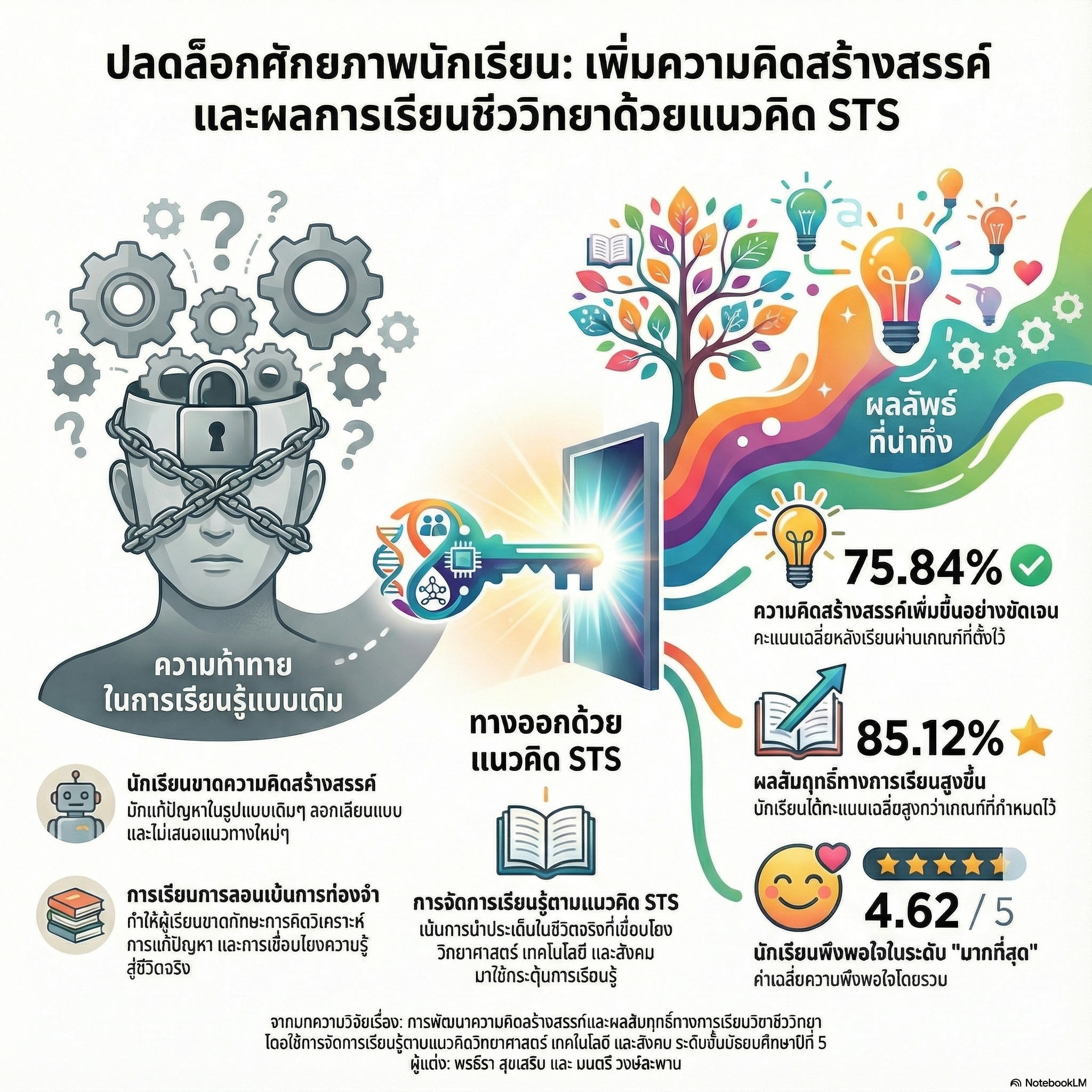
The purpose of this research was to develop creative thinking and biology learning achievement of Grade 11 students through Science, Technology, and Society (STS) learning management using a 5-step approach to meet the 75% criterion, and to study student satisfaction toward the learning management. The study was conducted through systematic action research cycles following the PAOR cycle approach for 3 rounds, beginning with presenting issues or situations connected to daily life to stimulate students to generate questions about their curiosities. Students then sought causes and solutions by applying creative thinking and exchanged knowledge within their groups. Subsequently, they created products to disseminate knowledge and applied their acquired knowledge to achieve real results in daily life. The target group consisted of Grade 11 students from one classroom in a school in Khon Kaen Province, totaling 28 students studying in the second semester of the 2024 academic year, purposively selected from a classroom with low learning achievement. This group was chosen because these students often have potential that has not been fully developed, and receiving creative thinking development would help them understand content more deeply rather than focusing solely on memorization. The research findings revealed that: 1) Students achieved creative thinking scores after learning management in the third action cycle that met the 75% criterion, with an average score of 75.84; 2) Students achieved learning outcomes that met the 75% criterion after learning management, with an average score of 25.54, equivalent to 85.12%; and 3) Students expressed satisfaction toward the learning management at the highest satisfaction level.
References
ชาตรี ฝ่ายคำตา. (2559). การพัฒนาความคิดสร้างสรรค์ทางวิทยาศาสตร์ของนักเรียนมัธยมศึกษาตอนต้นโดยใช้การจัดการเรียนรู้ตามแนวคิด STS. วารสารศึกษาศาสตร์, 27(3), 112-125.
บุญชม ศรีสะอาด. (2553). การวิจัยเบื้องต้น (พิมพ์ครั้งที่ 8). กรุงเทพฯ: สุวีริยาสาส์น.
รัฐพล ทิสารัมย์ และคณะ. (2564). การพัฒนาความคิดสร้างสรรค์โดยการจัดการเรียนรู้ด้วยเทคนิคคิดนอกกรอบที่มีเว็บสนับสนุนสำหรับนักเรียนมัธยมศึกษาปีที่ 6 โรงเรียนสุวรรณภูมิพิทยไพศาล. ใน การประชุมทางวิชาการของมหาวิทยาลัยเกษตรศาสตร์ ครั้งที่ 59 สาขาศึกษาศาสตร์ (น. 2-11). กรุงเทพฯ: มหาวิทยาลัยเกษตรศาสตร์.
สถาบันส่งเสริมการสอนวิทยาศาสตร์และเทคโนโลยี. (2565). การประเมินความคิดสร้างสรรค์ใน PISA 2022. เข้าถึงได้จาก https://pisathailand.ipst.ac.th/infographics-pisaCreative-thinking-part1-2/
สมชาย วงศ์ประเสริฐ. (2564). การพัฒนาผลสัมฤทธิ์ทางการเรียนวิทยาศาสตร์ด้วยการจัดการเรียนรู้ตามแนวคิดวิทยาศาสตร์ เทคโนโลยี และสังคม. วารสารวิชาการและวิจัยสังคมศาสตร์, 16(1), 89-102.
สำนักงานเลขาธิการสภาการศึกษา กระทรวงศึกษาธิการ. (2551). ยุทธศาสตร์การพัฒนาคุณภาพการศึกษา ระเบียบวาระแห่งชาติ 2551-2555. กรุงเทพฯ: สำนักงานเลขาธิการสภาการศึกษา กระทรวงศึกษาธิการ.
อัมพวา รักบิดา. (2549). ผลของการจัดการเรียนรู้ตามแนวคิดวิทยาศาสตร์ เทคโนโลยี และสังคม ต่อผลสัมฤทธิ์ทางการเรียน ความสามารถในการคิดแก้ปัญหา และความพึงพอใจของนักเรียนชั้นมัธยมศึกษาปีที่ 5 (วิทยานิพนธ์ปริญญามหาบัณฑิต). ภูเก็ต: มหาวิทยาลัยสงขลานครินทร์.
Aikenhead, G. S. (2006). Science education for everyday life: Evidence-based practice. New York, NY: Teachers College Press.
Ayua, G. A., & Agbidye, A. (2020). Effect of science-technology-society strategy on entrepreneurial creativity among upper-basic school students. Journal of Science, Technology and Education, 4(9), 105-113.
Hu, W., & Adey, P. (2002). A scientific creativity test for secondary school students. International Journal of Science Education, 24(4), 389-403. doi:10.1080/09500690110098912
Kemmis, S., & McTaggart, R. (Eds.). (1988). The action research planner (3rd ed.). Geelong, Victoria: Deakin University Press.
Torrance, E. P. (1992). A national climate for creativity and invention. Gifted Child Today, 5(1), 10-14.
Wallestein, H. (1971). A dictionary of psychology. Maryland: Penguin Books.
Zeidler, D. L., & Nichols, B. H. (2009). Socioscientific issues: Theory and practice. Journal of Elementary Science Education, 21(2), 49-58.
Downloads
Published
How to Cite
Issue
Section
Categories
License
Copyright (c) 2025 Faculty of Education, Srinakharinwirot university

This work is licensed under a Creative Commons Attribution-NonCommercial-NoDerivatives 4.0 International License.


