POSSIBLE SELVES OF JUVENILE RECIDIVISTS IN JUSTICE SYSTEM OF JUVENILE AND FAMILY COURT
Keywords:
Reflexive Thematic Analysis, Possible Selves, Juvenile Recidivism, YouthAbstract
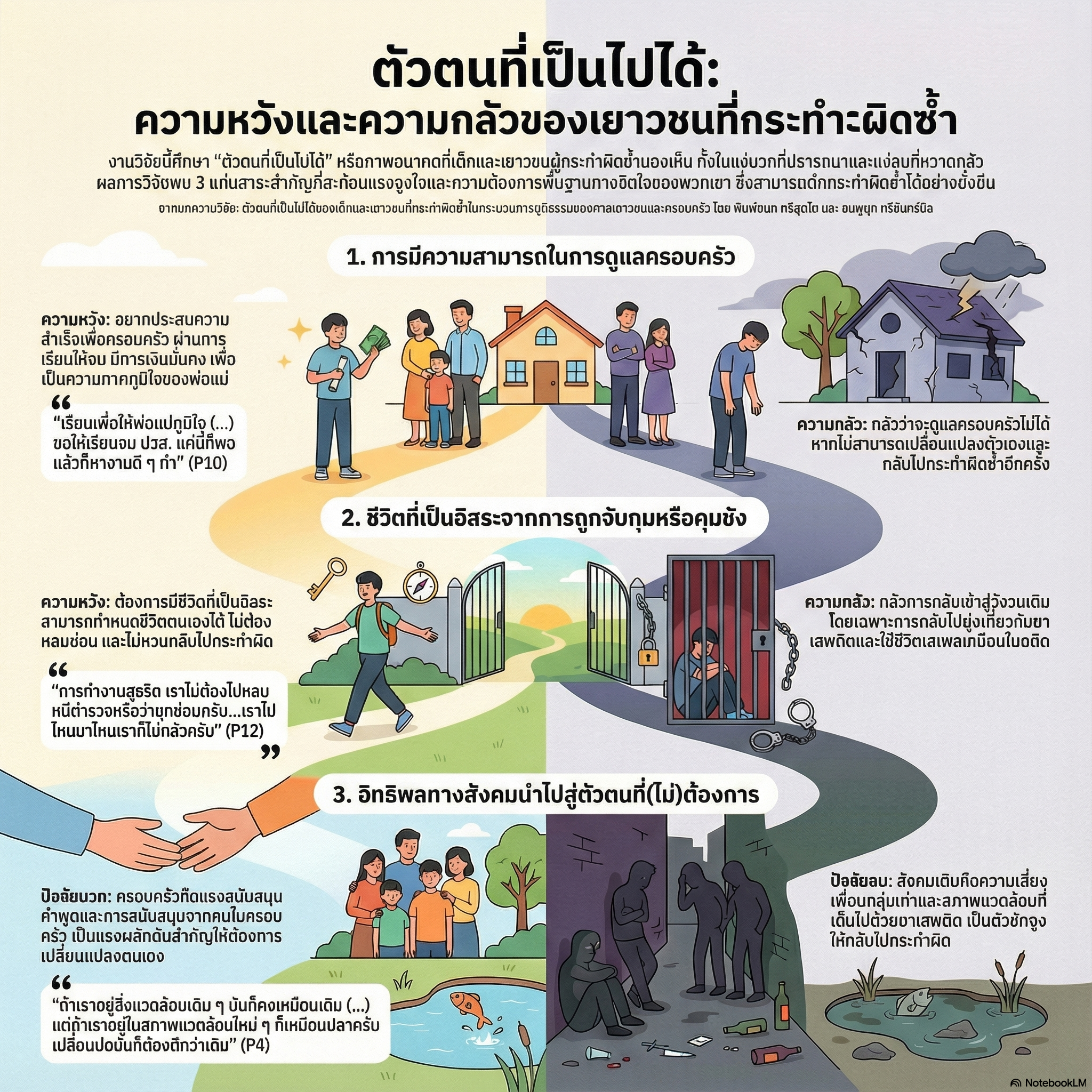
Research on possible selves, which reflects the motivations and life goals of youth who reoffend, remains limited. However, this information can serve as an important foundation for developing strategies to promote their potential and sustainably prevent recidivism. This study aims to explore the perceived possible selves of youth who reoffend within the juvenile justice process, specifically in the Juvenile and Family Court system, using Reflexive Thematic Analysis. The participants consisted of 12 youth who had previously reoffended, selected according to predefined criteria. Data were collected through semi-structured interviews that incorporated story completion tasks and open-ended questions to explore their perspectives and experiences. The findings revealed that these youth identified both positive and negative possible selves, which were categorized into three main themes: (1) the ability to care for their family, (2) a life free from detention or imprisonment, and (3) social influences leading to (un)desirable possible selves. Furthermore, their possible selves were closely linked to basic psychological needs, as outlined in Self-Determination Theory, including competence, autonomy, and relatedness. The results highlight the important role of family and community as supporting factors in fostering positive possible selves. These findings can inform the development of psychological counseling interventions and policies that promote family relationships and community support systems, ultimately contributing to sustainable prevention of recidivism.
References
กองยุทธศาสตร์และแผนงาน. (2563). รายงานสถิติคดี ประจำปี 2563. สืบค้นเมื่อจาก https://www.djop.go.th/storage/files/2/%E0%B8%A3%E0%B8%B2%E0%B8%A2%E0%B8%87%E0%B8%B2%E0%B8%99%E0%B8%9B%E0%B8%A3%E0%B8%B0%E0%B8%88%E0%B8%B3%E0%B8%9B%E0%B8%B5/year63-2.pdf
ดาราวรรณ รองเมือง, ยศพล เหลืองโมนภา, สุกัญญา ขันวิเศษ, และ ศิรดา วงษ์ระกา. (2562). อิทธิพลของการมองตนเองในอนาคตและระยะการเปลี่ยนแปลงพฤติกรรมสุขภาพต่อพฤติกรรมการจัดการตนเองและน้ำตาลสะสมในเลือดภายใต้การควบคุมอิทธิพลของความรู้เรื่องโรคเบาหวานในผู้ป่วยเบาหวานชนิดที่ 2. วารสารการพยาบาลและการศึกษา, 12(2), 34–51.
ตะวันฉาย มิตรประชา. (2557). ปัจจัยที่มีอิทธิพลต่อการกระทำความผิดซ้ำของเยาวชน เพื่อหาแนวทางในการพัฒนาเยาวชนภายหลังการปล่อยตัว. วารสารวิชาการมหาวิทยาลัยปทุมธานี, 6(1), 34–46.
ปาริชาต รังคกูลนุวัฒน์. (2549). การพัฒนาแบบวัดแบบแผนภาพลักษณ์ปัจจุบันและแบบแผนภาพลักษณ์อนาคตสำหรับหญิงไทยวัยกลางคน. (วิทยานิพนธ์ปริญญาโท). มหาวิทยาลัยเชียงใหม่.
พัชรินทร์ ซำศิริพงษ์. (2561). การกระทำผิดซ้ำของเด็กและเยาวชนในคดียาเสพติด. วารสารวิจัยราชภัฏกรุงเก่า สาขามนุษยศาสตร์และสังคมศาสตร์, 5(3), 23–30.
ศิริวรรณ กมลสุขสถิต. (2563). แนวทางในการป้องกันและแก้ไขการกระทำผิดซ้ำของเด็กและเยาวชนในคดีความผิดเกี่ยวกับยาเสพติดโดยอาศัยปัจจัยที่เป็นตัวทำนายทางด้านอาชญาวิทยา. วารสารวิชาการมนุษยศาสตร์และสังคมศาสตร์ มหาวิทยาลัยราชภัฏนครสวรรค์, 7(1), 1–19.
ศูนย์ข้อมูลและสถิติกรมพินิจและคุ้มครองเด็กและเยาวชน. (ม.ป.ป.). สถิติคดีปีปฏิทินทั่วประเทศ. สืบค้นเมื่อจาก https://doc.djop.go.th/public/cms_all_stat_cmsfccc.php
Bahr, S. J., Hoffmann, J. P., & Yang, X. (2005). Parental and peer influences on the risk of adolescent drug use. The Journal of Primary Prevention, 26(6), 529–551. doi:10.1007/s10935-005-0014-8
Braun, V., & Clarke, V. (2022). Thematic analysis: A practical guide. SAGE Publications Ltd.
Markus, H., & Nurius, P. (1986). Possible selves. American Psychologist, 41(9), 954–969. doi:10.1037/0003-066X.41.9.954
Muris, P. (2015). Guilt, shame, and psychopathology in children and adolescents. Child Psychiatry & Human Development, 46(2), 177–179. doi:10.1007/s10578-014-0488-9
Nagpaul, T., & Chen, J. (2019). Self-determination theory as a framework for understanding needs of youth at-risk: Perspectives of social service professionals and the youth themselves. Children and Youth Services Review, 99, 328–342. doi:10.1016/j.childyouth.2019.02.015
Newberry, A. L., & Duncan, R. D. (2001). Roles of boredom and life goals in juvenile delinquency. Journal of Applied Social Psychology, 31(3), 527–541. doi:10.1111/j.1559-1816.2001.tb02054.x
Oyserman, D., & Markus, H. R. (1990). Possible selves and delinquency. Journal of Personality and Social Psychology, 59(1), 112–125. doi:10.1037/0022-3514.59.1.112
Petrich, D. M. (2020). A self-determination theory perspective on human agency, desistance from crime, and correctional rehabilitation. Journal of Developmental and Life-Course Criminology, 6(3), 353–379. doi:10.1007/s40865-020-00141-9
Ryan, R. M., & Deci, E. L. (2000). The darker and brighter sides of human existence: Basic psychological needs as a unifying concept. Psychological Inquiry, 11(4), 319–338. doi:10.1207/S15327965PLI1104_03
Sapp, M. (2006). The strength-based model for counseling at-risk youths. The Counseling Psychologist, 34(1), 108–117. doi:10.1177/0011000005282370
Smith, E. J. (2006). The strength-based counseling model. The Counseling Psychologist, 34(1), 13–79. doi:10.1177/0011000005277018
Zeigler-Hill, V., & Shackelford, T. K. (Eds.). (2020). Encyclopedia of personality and individual differences. Springer International Publishing. doi:10.1007/978-3-319-24612-3
Downloads
Published
How to Cite
Issue
Section
Categories
License
Copyright (c) 2025 Faculty of Education, Srinakharinwirot university

This work is licensed under a Creative Commons Attribution-NonCommercial-NoDerivatives 4.0 International License.


