EFFECTS OF PROCESS ART EXPERIENCE PROVISION TO DEVELOP RELATIONSHIP SKILLS OF EARLY CHILDHOOD
Keywords:
Relationship skills, Early childhood, Process artAbstract
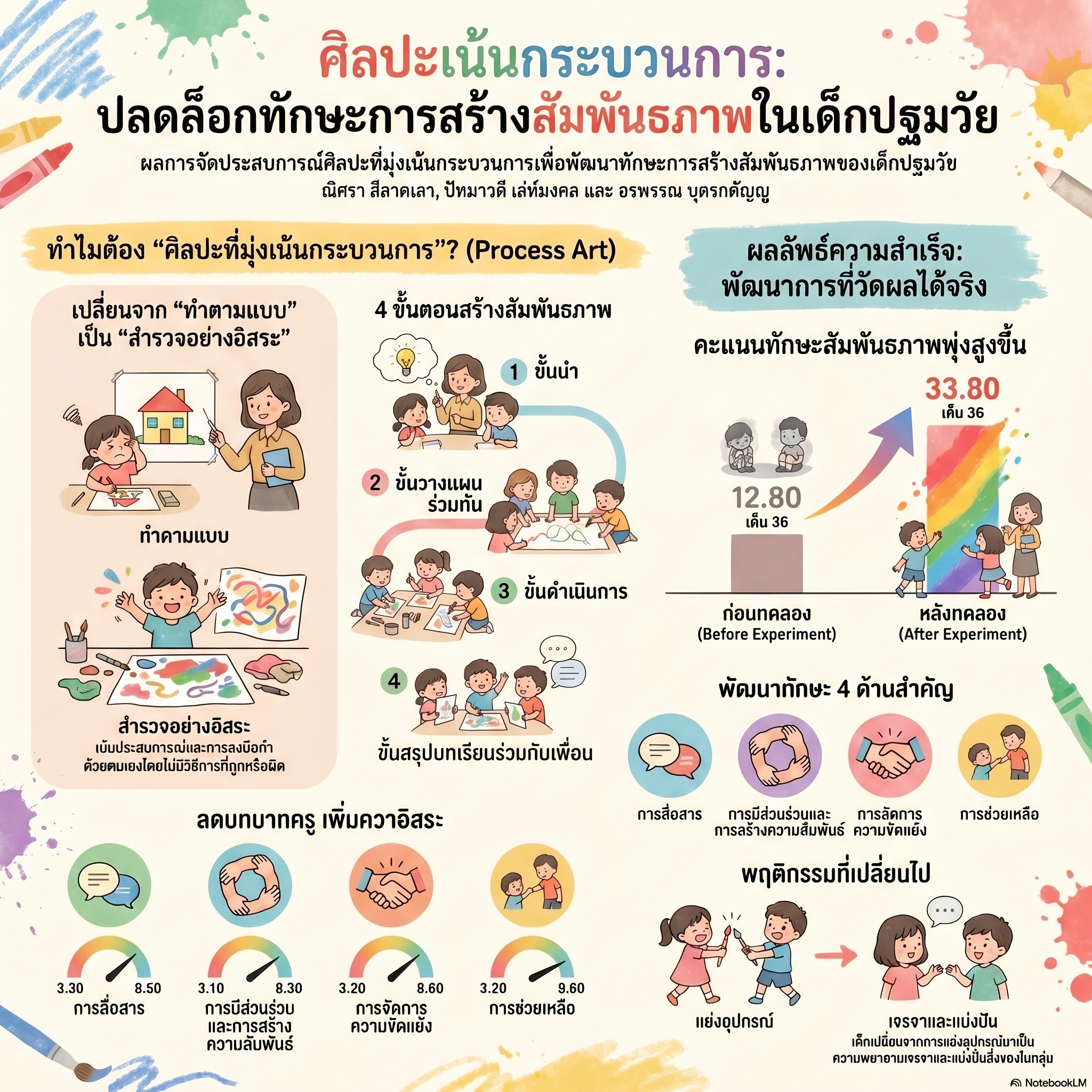
This study aimed to investigate the effects of process art experience provision to develop relationship skills of early childhood students. The target group consisted of 10 early childhood children, both male and female, aged between 5-6 years, studying in Kindergarten 3, second semester of the academic year 2024, at Kasem Pittaya School, Kindergarten Department, Wattana District, Bangkok, under the Office of the Private Education Commission. The participants were selected through purposive sampling with the following criteria: 1) For this study, the educational institution had 2 Kindergarten 3 classrooms, and the researcher specifically selected the classroom where they served as the homeroom teacher to facilitate continuous data collection and implementation of planned activities; and 2) From the total of 14 children in the selected classroom, the researcher excluded children with special needs to ensure that the target group's characteristics aligned with the scope and objectives of the study. The research instruments included: 1) Process art experience plans for developing relationship skills in early childhood, with an Index of Item-Objective Congruence (IOC) of 0.92, deemed appropriate for implementation; and 2) An observation form for early childhood relationship-building skills, comprising communication, social participation and relationship building, conflict management, and requesting and offering assistance, with an IOC of 0.93 for all items. The statistics used for data analysis included mean, standard deviation, and qualitative data analysis using content analysis. The results showed that: 1) Before the intervention, early childhood children had a mean score of 12.80 in relationship skills; 2) After receiving the process-oriented art experiences, the mean score of early childhood children's relationship-building skills increased to 33.80.
References
กระทรวงศึกษาธิการ. (2560). คู่มือหลักสูตรการศึกษาปฐมวัย พุทธศักราช 2560 สำหรับเด็กอายุ 3-6 ปี. กรุงเทพฯ: โรงพิมพ์ชุมนุมสหกรณ์การเกษตรแห่งประเทศไทยจำกัด.
กองบรรณาธิการ. (2021). สาระ EF ชีวิต New normal ระวังเด็กขาดทักษะทางสังคมเพิ่มขึ้น. สำนักงานกองทุนสนับสนุนการสร้างเสริมสุขภาพ (สสส.) สืบค้นจาก https://www.rlg- ef.com/
กรมสุขภาพจิต กระทรวงสาธารณสุข. (2567). กรมสุขภาพจิตจับมือกรุงเทพมหานคร Kick off จัดระบบดูแลสุขภาพจิตและจิตเวชเด็กและวัยรุ่น เดินหน้าพัฒนาระบบบริการแบบครบวงจร. สืบค้นจากhttps://dmh.go.th/news-dmh/view.asp?id=31929
จริยา สันตานนท์. (2553). การพัฒนาสัมพันธภาพทางสังคมของเด็กปฐมวัยโดยการจัดกิจกรรมการวาดภาพต่อเติมจากภาพปะติดเป็นกลุ่ม. (วิทยานิพนธ์ศึกษาศาสตรมหาบัณฑิต). กรุงเทพฯ: มหาวิทยาลัยศรีนครินทรวิโรฒ.
รังสิรัศม์ วงศ์อุปราช เเละศศิลักษณ์ ขยันกิจ. (2561). แนวทางการจัดการเรียนรู้ทางอารมณ์และสังคมเพื่อป้องกันและแก้ไขปัญหาทางพฤติกรรมและอารมณ์สำหรับเด็กปฐมวัย. วารสารวิชาการศึกษาศาสตร์ ศรีนครินทรวิโรฒ, 19(1), 160-173.
รัตนมน เกษจุฬาศรีโรจน์. (2562). การศึกษากระบวนการพัฒนาการเรียนรู้ทางอารมณ์และสังคม สำหรับเด็กในช่วงรอยเชื่อมต่อทางการศึกษาจากชั้นเรียนอนุบาลสู่ชั้นเรียนประถมศึกษาปีที่ 1. (วิทยานิพนธ์ศึกษาศาสตรมหาบัณฑิต). กรุงเทพฯ: จุฬาลงกรณ์มหาวิทยาลัย.
สำนักงานเลขาธิการสภาการศึกษา. (2568). เปิดสภาวะการศึกษาไทยไตรมาสแรกปี 68 การจัดการศึกษาไทยในโลกที่เปลี่ยนแปลงไป. สืบค้นจาก https://www.onec.go.th/th.php/page/view/Newseducation/6027
อัจฉรีย์ ไกรกิจราษฎร์. (2561). การพัฒนาทักษะทางสังคมของเด็กปฐมวัยโดยใช้กิจกรรมกลุ่มสัมพันธ์. วารสารศึกษาศาสตร์, 23(2), 351-361.
Bright Horizons Education Team. (2024). Process art for children. Retrieved from. http://www.brighthorizons.com/family-resources/art-projects-for-kids-process-oriented-art/,
Laurel Bongiorno. (2014). How process art experiences support preschoolers. Teaching Young Children. Teaching Young Children, 7(3), 18–19. Retrieved from http://www.saskecec.ca/ckfinder/userfiles/files/Bongiorno.pdf
Collaborative for Academic, Social, and Emotional Learning CASEL. (2016). education heartsinspiring minds. Retrieved from. https://casel.org/fundamentals-of-sel/what-is-the-casel-framework/
Collaborative for Academic, Social, and Emotional Learning CASEL. (2012). Effective social and emotionallearning programs: Preschool and elementary school edition. Retrieved from. https://files.eric.ed.gov/fulltext/ED581699.pdf
Competence of preschool children. Psychology in the Schools, 48(5), 513-540. Ministry of Education Republic of Singapore. (2013). Social and emotional development. Nurturing early learners: A curriculum for kindergartens in Singapore, 7.
Educational Playcare. (2018). Product Art vs. Process Art. Research Guides Baker College. Retrieved from. https:// guides. baker.edu/ECE1410/
Katie. (2019). Process art vs. product art: What is the difference. Retrieved from. https://www. giftofcuriosity.com/process-art-vs-product-art-what-is-the-difference/
Massachusetts Standards for Preschool and Kindergarten. (2015). Social and Emotional Learning,and Approaches to Play and Learning. University of Massachusetts Boston. 7(10), 15-18.
NAEYC. (2014, February - March ). How Process-Focused Art Experiences Support Preschoolers. Teaching Young Children. Retrieved from. https://www.naeyc.org/resources/pubs/tyc/feb2014/process-art-experiences/
Sally Haughey. (2023). The Complete Guide To Process Art By Sally Haughey, Founder of Wunderled. Fairy Dust Teaching,
Downloads
Published
How to Cite
Issue
Section
Categories
License
Copyright (c) 2025 Faculty of Education, Srinakharinwirot university

This work is licensed under a Creative Commons Attribution-NonCommercial-NoDerivatives 4.0 International License.


