A STUDY OF INTERPERSONAL RELATIONSHIPS OF GRADUATE DIPLOMA PROGRAM STUDENTS OF THE ACADEMIC TAPEE UNIVERSITY
Keywords:
interpersonal relationships, interpersonal relationships scale, Graduate Diploma Program studentsAbstract
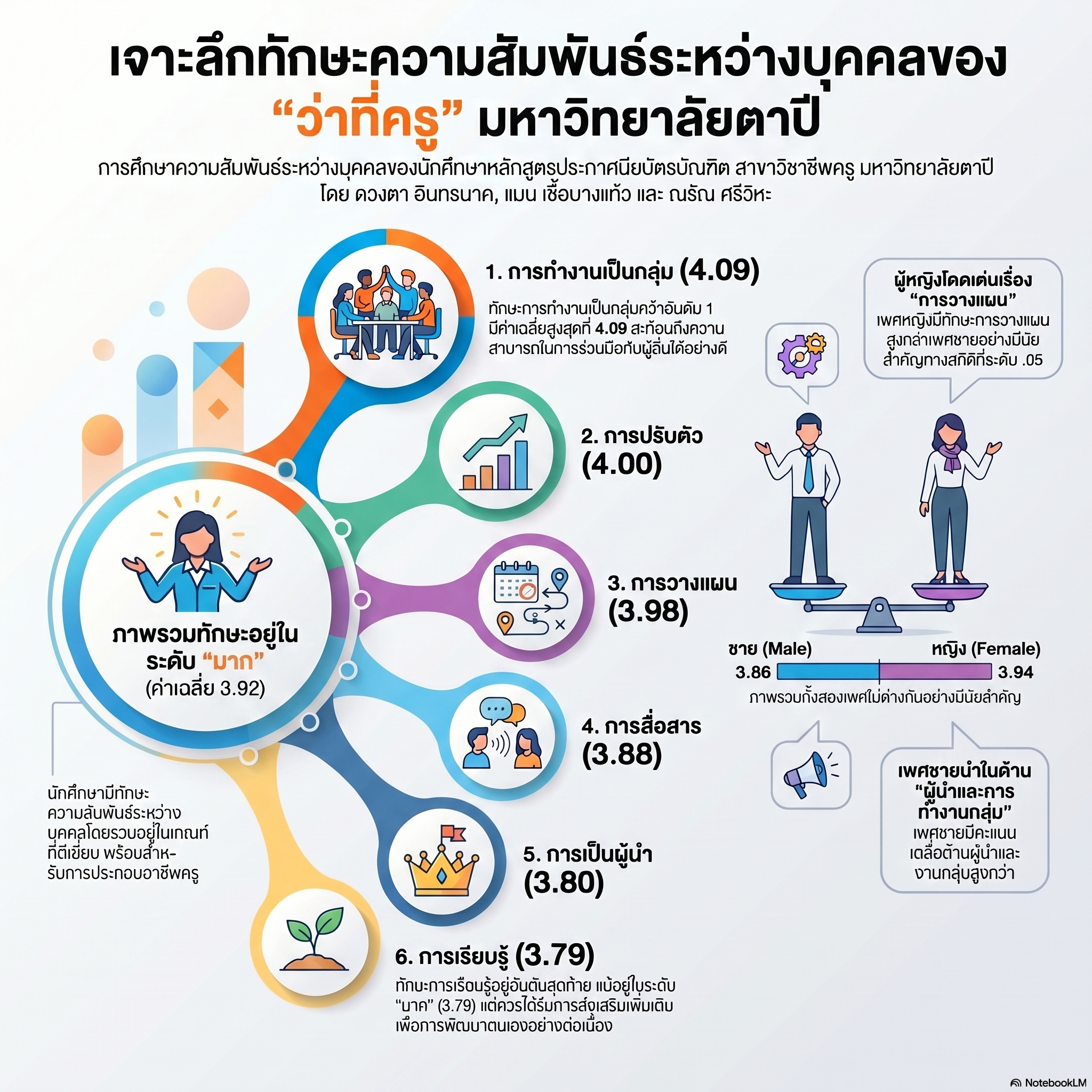
This research aimed to analyze the level of interpersonal relationship skills of the Graduate Diploma Program students in Teaching Profession at Tapee University. The sample group used in this research consisted of 30 students in the Graduate Diploma Program in Teaching Profession, Tapee University, selected by cluster sampling. The instrument was the Interpersonal Relationship Assessment Scale. The statistics were mean, standard deviation and t-test. The research results found that (1) students in the Graduate Diploma in Teaching Profession Program at Tapee University demonstrated an overall high level of interpersonal relationship skills, when considering the skills in building interpersonal relationships in each skill, it was found that teamwork skills had the highest mean score, followed by adaptability skills, planning skills, communication skills, leadership skills, and learning skills, respectively, and all skills have a high average value. (2) Female students in the Graduate Diploma in Teaching Profession Program at Tapee University had a higher average level of interpersonal relationship skills than male students; however, the difference was not statistically significant. When examining each specific interpersonal skill, female students scored significantly higher in planning skills than male students at the .05 level of significance. For communication skills, adaptation skills, and learning skills, female students had higher average scores than male students, but these differences were not statistically significant. In contrast, male students had higher average scores in leadership skills and teamwork skills than female students, although these differences were also not statistically significant.
References
กฎกระทรวง มาตรฐานคุณวุฒิระดับอุดมศึกษา พ.ศ. 2565. (2565, 31 มีนาคม). ราชกิจจานุเบกษา. เล่ม 139 ตอนที่ 20 ก. หน้า 28-31.
กนกวรรณ ศรีทองสุก. (2559). ความสัมพันธ์ระหว่างการรับรู้การสนับสนุนจากองค์การ ความสัมพันธ์ระหว่างเพื่อนร่วมงานกับความสุขในการทำงานโดยมีความเชื่ออำนาจในการควบคุมภายในเป็นตัวแปรกำกับ. วิทยานิพนธ์ศิลปศาสตรมหาบัณฑิต, มหาวิทยาลัยธรรมศาสตร์.
เดโช แขน้ำแก้ว, เชษฐา มุหะหมัด, จิตติมา ดำรงวัฒนะ, ดำรงพันธ์ ใจห้าววีระพงศ์, และบุญยิ่ง ประทุม. (2564). คุณลักษณะด้านทักษะความสัมพันธ์ระหว่างบุคคลและรับผิดชอบของบัณฑิตพัฒนาชุมชนที่สำเร็จการศึกษาจากมหาวิทยาลัยราชภัฏนครศรีธรรมราช ระหว่างปี พ.ศ.2557-2561. Journal of Roi Kaensarn Academi. 6(12), 110-122.
ธนภรณ์ พรรณราย. (2565). ปัจจัยที่ส่งผลต่อประสิทธิภาพการปฏิบัติงานของบุคลากรองค์การบริหาร ส่วนจังหวัดสงขลา. ปริญญารัฐประศาสนศาสตรมหาบัณฑิต, มหาวิทยาลัยสงขลานครินทร์.
ประกาศคณะกรรมการมาตรฐานการอุดมศึกษา เรื่อง รายละเอียดผลลัพธ์การเรียนรู้ตามมาตรฐานคุณวุฒิระดับอุดมศึกษา พ.ศ. 2565. (2565, 9 กันยายน). ราชกิจจานุเบกษา. เล่ม 139 ตอนพิเศษ 212 ง. หน้า 35-36.
เพลินพิศ ศิริสมบูรณ์. (2559). คุณลักษณะบัณฑิตตามกรอบมาตรฐานคุณวุฒิระดับอุดมศึกษาแห่งชาติของวิทยาลัยเซาธ์อีสท์บางกอก ประจำปีการศึกษา 2556 - 2557 (รุ่นที่ 15). วารสารวิชาการเซาธ์อีสท์บางกอก, 2(2), 55-67.
ไพศาล วรคำ. (2565). การวิจัยทางการศึกษา (พิมพ์ครั้งที่ 13). มหาสารคาม: ตักสิลาการพิมพ์.
ราชบัณฑิตยสภา. (2564). พจนานุกรมศัพท์ศึกษาศาสตร์ ฉบับบัณฑิตราชสภา (พิมพ์ครั้งที่ 2). กรุงเทพฯ: สำนักงานราชบัณฑิตยสภา.
สำนักงานเลขาธิการสภาการศึกษา. (2560). แผนการศึกษาแห่งชาติ พ.ศ. 2560 – 2579. กรุงเทพฯ: บริษัท พริกหวานกราฟฟิค จำกัด.
Ary, D., Jacobs, L. C., Razavieh, A., & Sorensen, C. (2006). Introduction to Research in Education. Australia: Thomson Wadsworth.
Edwards, A. L. (1957). Techniques of Attitude Scale Construction. United States of America: Appleton-Century-Crofts. Inc.
Ganguly, T. K. (2022). Teacher–Student Relationship: A Conceptual Framework. Journal of Emerging Technologies and Innovative Research, 9(4), (April 2022), 861-873.
Hargie, O. (2022). Skilled interpersonal communication: research, theory and practice (7th ed.). New York, NY: Routledge.
Hayes, J. (2002). INTERPERSONAL SKILLS AT WORK (2nd ed.). New York: Routledge.
Kumar, R. (2017). EVALUATION OF INTERPERSONAL COMMUNICATION SKILLS OF THE COLLEGE STUDENTS. International Journal of Marketing & Financial Management, 5(6), 51-58.
Likert, R. (1932). A TECHNIQUE FOR THE MEASUREMENT OF ATTITUDES. ARCHIVES OF PSYCHOLOGY, 22(140), 5-55.
Maleki, N. A., Zoghi M., & Aidinlou, N. A. (2019). Investigating the Impacts of Teacher-Student Interactions on Improving Learners' Academic Achievements: The Role of Academic Interest. Journal of Language and Translation, 9(4). 105-119.
Munro, B. H. (2005). Statistical Methods for Health Care Research (5th ed.). Philadelphia: Lippincott Williams & Wilkins.
Rogers, C. R. (1959). A THEORY OF THERAPY, PERSONALITY, AND INTERPERSONAL RELATIONSHIPS, AS DEVELOPED IN THE CLIENT-CENTERED FRAMEWORK. In S. Koch (ed.), Psychology: A Study of a Science, 1(3), 184-256.
Sullivan, H. S. (1953). The Interpersonal Theory of Psychiatry. Oxfordshire: Tavistock Publications Limited.
Zhou, J. (2024). Interpersonal skills and self-efficacy among Chinese college students. International Journal of Research Studies in Education, 13(9), 153-160.
Downloads
Published
How to Cite
Issue
Section
Categories
License
Copyright (c) 2025 Faculty of Education, Srinakharinwirot university

This work is licensed under a Creative Commons Attribution-NonCommercial-NoDerivatives 4.0 International License.


