
นวัตกรรมการเรียนรู้เชิงจิตวิทยาร่วมสมัยเพื่อเสริมสร้างทักษะแห่งความสำเร็จสำหรับวัยทำงาน
คำสำคัญ:
นวัตกรรมเชิงจิตวิทยา, จิตวิทยาร่วมสมัย, ทักษะแห่งความสำเร็จ, บุคคลวัยทำงานบทคัดย่อ
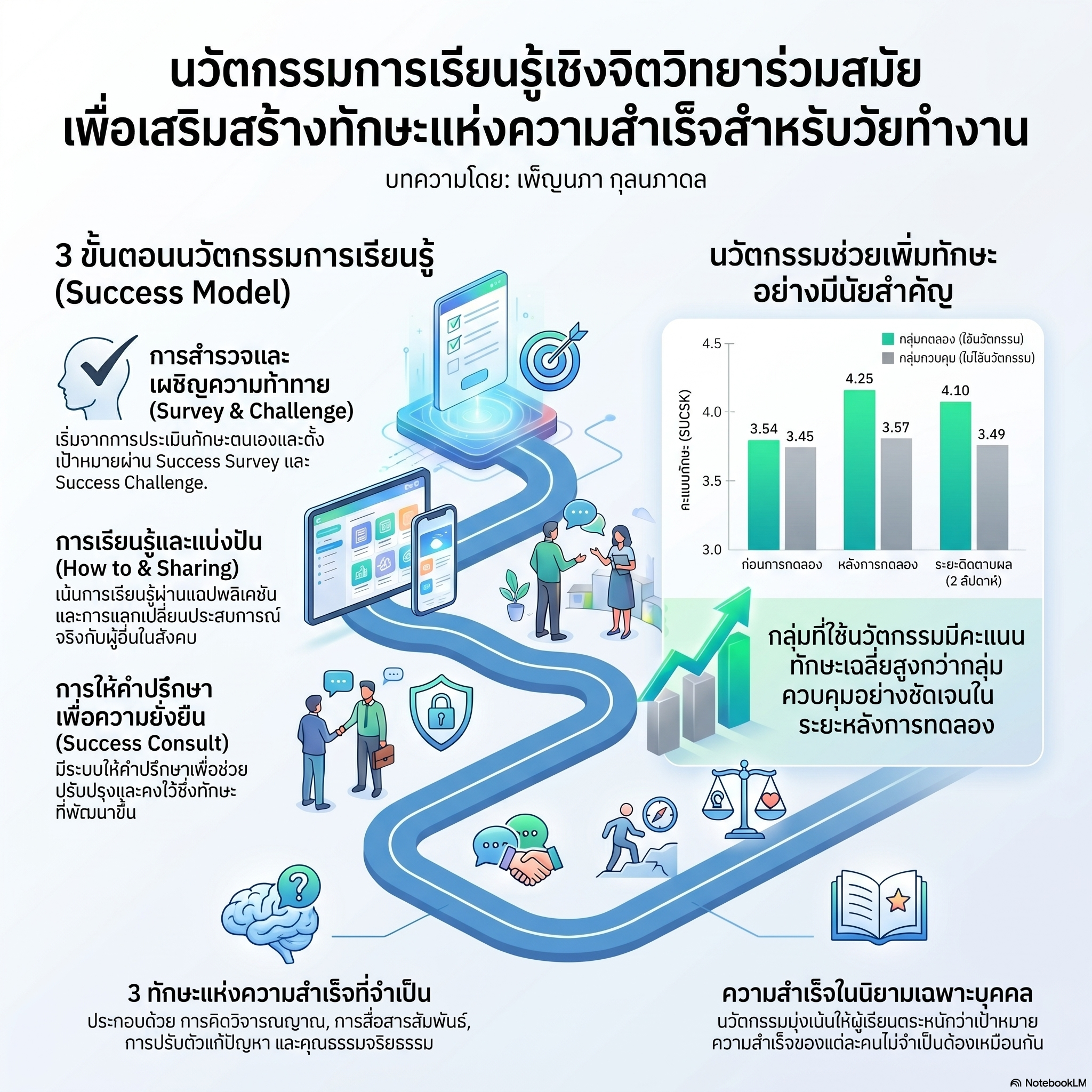
การวิจัยครั้งนี้ มีวัตถุประสงค์เพื่อพัฒนานวัตกรรมเชิงจิตวิทยาการเรียนรู้เชิงจิตวิทยาร่วมสมัยเพื่อเสริมสร้างทักษะแห่งความสำเร็จของบุคคลวัยทำงาน และศึกษาผลของนวัตกรรมเชิงจิตวิทยาการเรียนรู้เชิงจิตวิทยาร่วมสมัยเพื่อเสริมสร้างทักษะแห่งความสำเร็จของบุคคลวัยทำงาน โดยกลุ่มตัวอย่างถูกจำแนกเป็น 2 กลุ่มเท่า ๆ กัน เป็นกลุ่มทดลองและกลุ่มควบคุม กลุ่มละ 100 คน รวม เป็น 200 คน ดำเนินการทดลองด้วยแบบแผนการทดลองแบบ Randomized Control Group Pretest- Posttest-Follow up Design วิเคราะห์ข้อมูลด้วยเทคนิค Two-Way ANOVA Repeated Measurement ผลการศึกษาพบว่าทักษะแห่งความสำเร็จ (SUCSK) ของกลุ่มทดลอง (Experimental Group) ระยะก่อนการทดลองอยู่ในระดับมาก มีค่าเฉลี่ยเท่ากับ 3.54 ระยะหลังการทดลองอยู่ในระดับมาก มีค่าเฉลี่ยเท่ากับ 4.25 ระยะติดตามผลอยู่ในระดับมาก มีค่าเฉลี่ยเท่ากับ 4.10 กลุ่มควบคุม (Control Group) ระยะก่อนการทดลองอยู่ในระดับปานกลาง มีค่าเฉลี่ยเท่ากับ 3.45 ระยะหลังการทดลองอยู่ในระดับมาก มีค่าเฉลี่ยเท่ากับ 3.57 ระยะติดตามผลอยู่ในระดับปานกลาง มีค่าเฉลี่ยเท่ากับ 3.49
เอกสารอ้างอิง
ปาริชาติ ปาละนันทน์. (2557). อีเลิร์นนิ่งกับการจัดการเรียนการสอนในปัจจุบัน. วารสารวิชาการ มหาวิทยาลัยราชภัฏอุดรธานี, หน้า 146–160.
ยุทธศาสตร์แห่งชาติ. (2561). ยุทธศาสตร์ชาติ พ.ศ. 2561–2580 (ฉบับประกาศราชกิจจานุเบกษา). ค้นเมื่อ 15 กรกฎาคม 2563, จาก https://www.nesdc.go.th/download/document/SAC/NS_PlanOct2018.pdf
วิทยา วาโย, อภิรดี เจริญนุกูล, ฉัตรสุดา กานกายันต์, & จรรยา คนใหญ่. (2563). การเรียนการสอนแบบออนไลน์ภายใต้สถานการณ์แพร่ระบาดของไวรัส COVID-19: แนวคิดและการประยุกต์ใช้จัดการเรียนการสอน. วารสารศูนย์อนามัยที่ 9: วารสารส่งเสริมสุขภาพและอนามัยสิ่งแวดล้อม, 14(34), 285–298.
สำนักงานสถิติแห่งชาติ. (2562). สรุปผลการสำรวจภาวะการทำงานของประชากร. กระทรวงดิจิทัลเพื่อเศรษฐกิจและสังคม. จาก https://www.nso.go.th/nsoweb/nso/survey_detail/9u
Bronson, E. (2007). Career and technical education is ideally suited to teaching students the soft skills needed to succeed in the 21st century workplace. Techniques: Connecting Education & Careers, 82(7), 30–31.
Brooks, R., Flanders, A., Jones, M., Kane, S. P., McKissick, J. C., & Shepherd, T. (2008). A study of the workforce training needs for the agribusiness industry in Georgia. Athens: University of Georgia Research Foundation.
Coulombe, D. (1984). Two-way ANOVA with and without repeated measurements, tests of simple main effects, and multiple comparisons for microcomputers. Behavior Research Methods, Instruments, & Computers, 16(4), 397–398.
Faul, F., Erdfelder, E., Lang, A. G., & Buchner, A. (2007). G* Power 3: A flexible statistical power analysis program for the social, behavioral, and biomedical sciences. Behavior Research Methods, 39(2), 175–191.
NCWorks. (2018). Employer Needs Survey. Retrieved from https://www.nccommerce.com/Portals/11/Documents/Commission/2018-Employer-Needs-Survey.pdf
Rausch, J. R., Maxwell, S. E., & Kelley, K. (2003). Analytic methods for questions pertaining to a randomized pretest, posttest, follow-up design. Journal of Clinical Child and Adolescent Psychology, 32(3), 467–486.
Schneider, C. G. (2015). The LEAP Challenge: Transforming for students, essential for liberal education. Liberal Education, 101(1/2).
ดาวน์โหลด
เผยแพร่แล้ว
รูปแบบการอ้างอิง
ฉบับ
ประเภทบทความ
หมวดหมู่
สัญญาอนุญาต
ลิขสิทธิ์ (c) 2025 คณะศึกษาศาสตร์ มหาวิทยาลัยศรีนครินทรวิโรฒ

อนุญาตภายใต้เงื่อนไข Creative Commons Attribution-NonCommercial-NoDerivatives 4.0 International License.


