GUIDELINES FOR PROMOTING INNOVATIVE ORGANIZATION OF SCHOOLS UNDER PHICHIT SECONDARY EDUCATIONAL SERVICE AREA OFFICE
Keywords:
Guidelines for Promoting, Innovative OrganizationAbstract
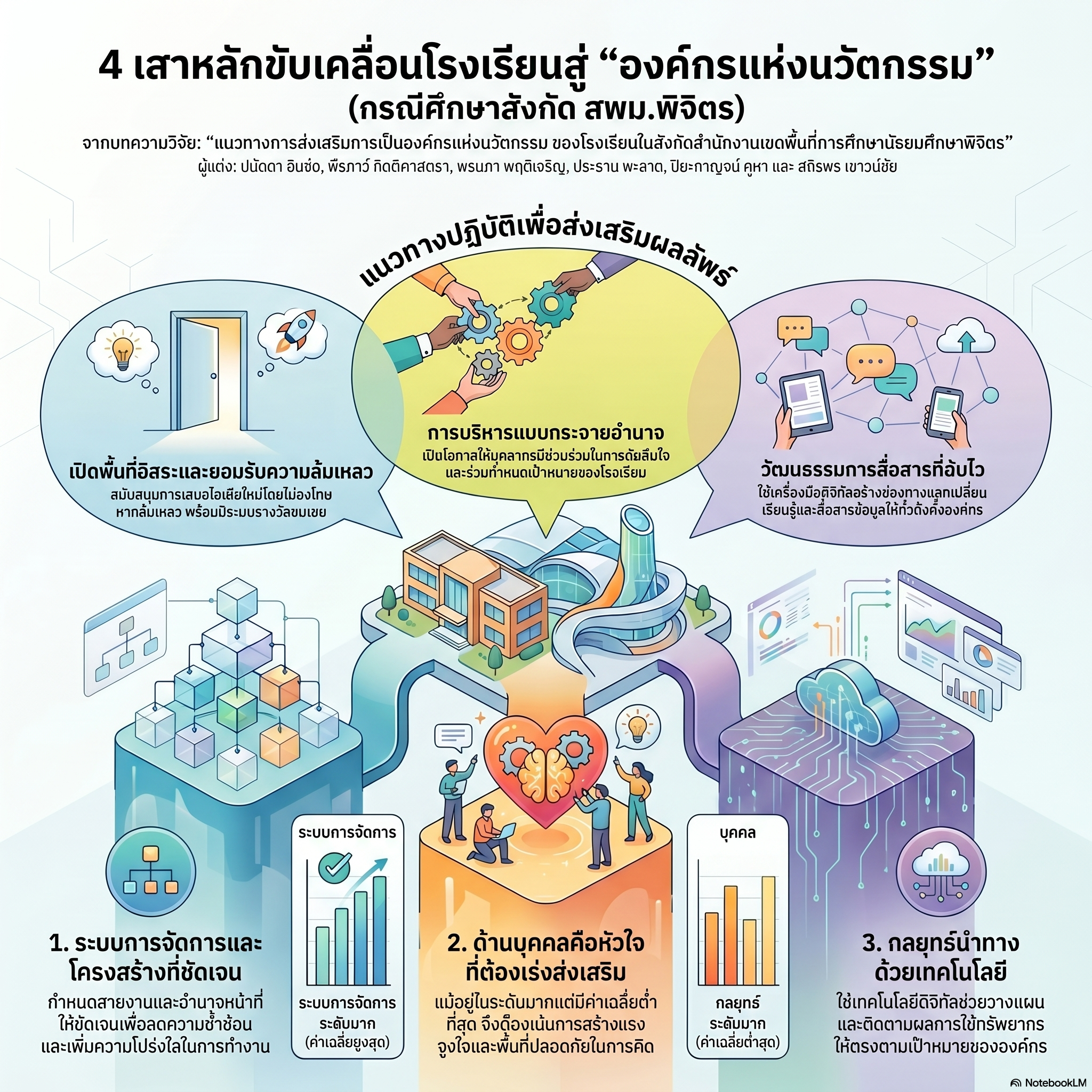
This research aimed to 1) to study the level of innovative organization in schools under Phichit Secondary Educational Service Area Office and (2) to propose strategies for promoting schools under this office to become innovative organizations. The sample consisted of 337 school administrators and teachers selected using stratified random sampling based on school size. Data were collected using a five-level rating scale questionnaire with a reliability coefficient of 0.95. The data were analyzed using mean () and standard deviation (S.D.). Phase 2 find guidelines for promoting innovative organization in schools under Phichit Secondary Educational Service Area Office. The group of informants consisted of 3 experts by specific selection method. The research instrument was an interview form on guidelines for promoting innovative organization. The data were analyzed using content analysis. The research results revealed that 1) The level of innovative organization in schools under Phichit Secondary Educational Service Area Office was at a high level overall. When considering each aspect, it was found that the aspect with the highest average value was the management system, at a high level. Followed by organizational structure, at a high level and the aspect with the lowest average value was the personnel, at a high level. 2) Guidelines for promoting innovative organization in schools under Phichit Secondary Educational Service Area Office included administrators should allocate resources according to strategic plans by analyzing the needs of each department; use technology for planning and monitoring to ensure flexibility, transparency and accountability in administration; clearly define the structure of work lines and authorities; support decentralization and personnel participation; allow free expression of new ideas; use digital tools to create spaces for exchanging opinions; and encourage initiatives without penalizing failure. Additionally, joint goals should be established, communication systems developed, and management carried out based on real data to continuously promote innovation and effectively adapt to changing circumstances.
References
จิติมา วรรณศรี. (2564). นวัตกรรมสู่การพัฒนาสถานศึกษา. พิษณุโลก: รัตนสุวรรณการพิมพ์ 3.
ณัฐปภัสร์ สกุลพัฒน์รดา. (2564). การเป็นองค์กรนวัตกรรมทางการศึกษาของโรงเรียนมัธยมศึกษาที่ได้รับรางวัลคุณภาพแห่งสำนักงานคณะกรรมการการศึกษาขั้นพื้นฐาน [วิทยานิพนธ์ปริญญามหาบัณฑิต, มหาวิทยาลัยศรีนครินทรวิโรฒ].
ธัญรดี หิรัญกิตติกร. (2564). การศึกษาความต้องการความเป็นองค์กรนวัตกรรมของโรงเรียนในสังกัดสำนักงานเขตภาษีเจริญ กรุงเทพมหานคร [วิทยานิพนธ์ปริญญามหาบัณฑิต, มหาวิทยาลัยรังสิต].
ภารดี อนันต์นาวี. (2564). องค์กรนวัตกรรมทางการศึกษา: การบริหารจัดการ. วารสารวิชาการมหาวิทยาลัยนอร์ทกรุงเทพ, 10(2), 10–19.
มรกต จันทร์กระพ้อ, & กฤษดา เชียรวัฒนสุข. (2562). การสร้างองค์การแห่งนวัตกรรมเพื่อขับเคลื่อนสู่ความเป็นเลิศขององค์การ. วารสารนักบริหาร, 39(1), 52–66.
วสันต์ สุทธาวาศ, & พิทักษ์ ศิริวงศ์. (2558). ความเป็นนวัตกรทางการศึกษาขั้นพื้นฐานในภาครัฐ: การศึกษาทฤษฎีฐานราก. Veridian E-Journal ฉบับมนุษยศาสตร์ สังคมศาสตร์ และศิลปะ, 8(2), 281–300. https://he02.tci-thaijo.org/index.php/Veridian-E-Journal/article/view/40205/33156
วุฒิพงษ์ ภักดีเหลา. (2554). การศึกษาคุณลักษณะขององค์การนวัตกรรม: กรณีศึกษาองค์การที่ได้รับรางวัลด้านนวัตกรรม [วิทยานิพนธ์ปริญญามหาบัณฑิต, สถาบันบัณฑิตพัฒนบริหารศาสตร์].
สถาบันเพิ่มผลผลิตแห่งชาติ. (2562). องค์กรนวัตกรรม: หลักการและแนวทางการสร้างสรรค์. กรุงเทพฯ: สถาบันเพิ่มผลผลิตแห่งชาติ.
สถิรพร เชาวน์ชัย. (2561). เอกสารประกอบการสอน การวิจัยทางการบริหารการศึกษา. พิษณุโลก: การพิมพ์ดอทคอม.
สถิรพร เชาวน์ชัย. (2567). การบริหารงานวิชาการในสถานศึกษาเพื่อพัฒนาคุณภาพผู้เรียน: Academic administration in school to develop student quality. พิษณุโลก: การพิมพ์ดอทคอม.
สำนักงานเขตพื้นที่การศึกษามัธยมศึกษาพิจิตร. (2567). สารสนเทศสำนักงานเขตพื้นที่การศึกษามัธยมศึกษาพิจิตร. จาก https://sesaopc.go.th/ประกาศนโยบาย-สพม-พิจิตร/
สำนักงานนวัตกรรมแห่งชาติ. (2563). แนวทางการพัฒนาองค์กรนวัตกรรม. กรุงเทพฯ: สนช.
สำนักงานเลขาธิการสภาการศึกษา. (2561). ทิศทางการศึกษาไทยในยุค 4.0. กรุงเทพฯ: สกศ.
สิทธิ์ ธีรสรณ์. (2560). เทคนิคการเขียนบทความวิชาการ (พิมพ์ครั้งที่ 5). กรุงเทพฯ: สำนักพิมพ์แห่งจุฬาลงกรณ์มหาวิทยาลัย.
สุธรรม ธรรมทัศนานนท์. (2564). การบริหารสู่องค์การแห่งนวัตกรรมการศึกษา. มหาสารคาม: ตักสิลาการพิมพ์.
อนุพงษ์ ชุมแวงวาปี. (2560). การพัฒนารูปแบบองค์การแห่งนวัตกรรมของโรงเรียนมัธยมศึกษา สังกัดสำนักงานคณะกรรมการการศึกษาขั้นพื้นฐาน [ดุษฎีนิพนธ์ปริญญาดุษฎีบัณฑิต, มหาวิทยาลัยบูรพา].
Hoidn, S., & Karkkaunen. (2014). Promoting skill for innovation in higher education: A literature review on the effectiveness of problem-based learning and of teaching behaviors. N.P.: OECD Education Working Paper.
Horth, D. (2014). Innovation leadership: How to use innovation to lead effectively, work collaboratively, and drive results. Greensborough, NC: Center for Creative Leadership.
Tidd, J., Bessant, J., & Pavitt, K. (2001). Managing innovation: Integrating technological, market and organizational change (2nd ed.). Chichester: John Wiley & Sons.
Downloads
Published
How to Cite
Issue
Section
Categories
License
Copyright (c) 2025 Faculty of Education, Srinakharinwirot university

This work is licensed under a Creative Commons Attribution-NonCommercial-NoDerivatives 4.0 International License.


