GUIDELINES FOR ENHANCING INTERNAL SUPERVISION WITH DIGITAL TECHNOLOGY IN SCHOOLS UNDER THE SECONDARY EDUCATIONAL SERVICE AREA OFFICE, PHITSANULOK-UTTARADIT
Keywords:
Internal supervision, Digital technology, Online supervisionAbstract
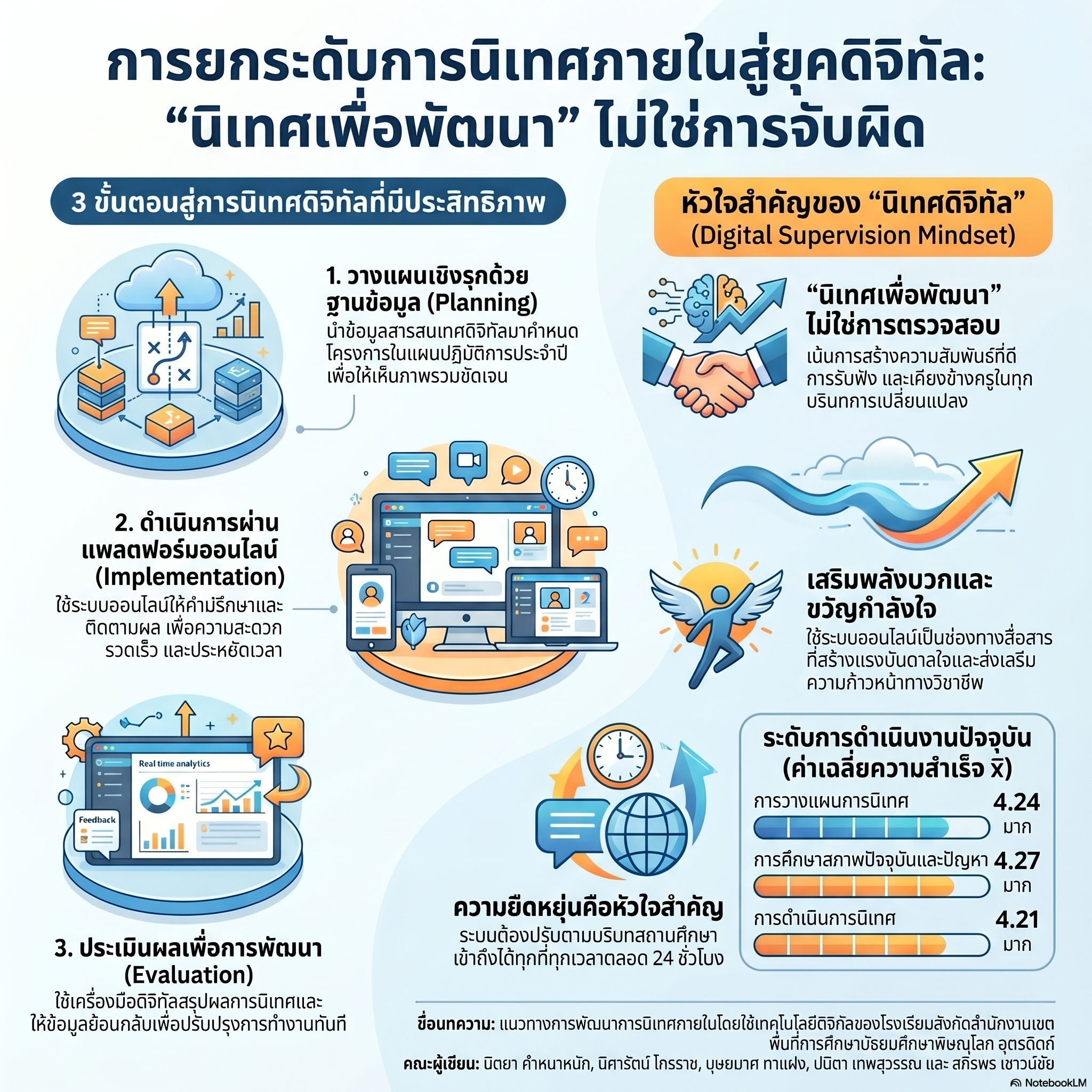
This study aimed to explore the development of internal supervision using digital technology in schools under the Secondary Educational Service Area Office Phitsanulok-Uttaradit. The research was conducted in two phases. In the first phase, the study investigated the current practices of internal supervision using digital tools among school administrators in the academic year 2024. The sample consisted of 63 secondary school administrators selected through simple random sampling. The data collection instrument was a five-level rating scale questionnaire. The data were analyzed using mean (𝑥̅) and standard deviation (S.D). In the second phase, the study focused on formulating guidelines for developing internal supervision using digital technology. The key informants were three experts selected by purposive sampling. Data were gathered through interviews and analyzed using content analysis. The findings revealed that: 1. Among the various aspects, the highest mean score was in digital-based supervision planning (𝑥̅ = 4.24, S.D. = 0.70), followed by the assessment of the current situation, problems, and needs in internal supervision using digital tools (𝑥̅ = 4.27, S.D. = 0.73). The next was the implementation of internal supervision through digital innovations (𝑥̅ = 4.21, S.D. = 0.78), and the lowest was in evaluation and improvement of internal supervision using digital technology (𝑥̅ = 4.17, S.D. = 0.82). 2. The proposed guidelines for developing internal supervision in schools under the Phitsanulok-Uttaradit Secondary Educational Service Area suggest that effective online supervision systems should be goal-oriented, developmental, flexible, communicative, and supportive of teachers’ professional growth. Emphasis should be placed on building strong relationships among school administrators, supervisors, and teachers through inspirational communication and participatory approaches. The concept of “supervision for development” should be central—not only offering convenience and time efficiency, but also serving as a key mechanism to enhance educational quality. This approach promotes teacher well-being, motivation, and professional growth, with educational supervisors acting as academic leaders who listen, empower, and support teachers throughout every stage of educational change—ensuring that teachers feel genuinely supported, not inspected, thereby fostering positive energy in their work.
References
จักรกฤษณ์ กังหัน. (2565). การศึกษาและการดำเนินการดำเนินการนิเทศภายในเทคโนโลยีดิจิทัลของโรงเรียนเอกชนจังหวัดแพร่ [วิทยานิพนธ์การศึกษามหาบัณฑิต, มหาวิทยาลัยนเรศวร].
จิตติมา วรรณศรี. (2557). การบริหารงานวิชาการในสถานศึกษา. พิษณุโลก: คณะศึกษาศาสตร์ มหาวิทยาลัยนเรศวร.
ดาวรุวรรณ ถวิลการ. (2564). ภาวะผู้นำดิจิทัล. ขอนแก่น: คณะศึกษาศาสตร์ มหาวิทยาลัยขอนแก่น.
ธวัชชัย นิลสนธิ. (2566). แนวทางการพัฒนาการดำเนินงานนิเทศภายในของโรงเรียนวัดชินวราราม (เจริญผลวิทยาเวศม์) [วิทยานิพนธ์ปริญญามหาบัณฑิต, มหาวิทยาลัยศิลปากร].
ปรียาพร วงศ์อนุตรโรจน์. (2546). การนิเทศการสอน. กรุงเทพมหานคร: ศูนย์สื่อเสริมกรุงเทพ.
มหาวิทยาลัยสุโขทัยธรรมาธิราช. (2564). การนิเทศภายในสถานศึกษา. กรุงเทพฯ: โรงพิมพ์มหาวิทยาลัยสุโขทัยธรรมาธิราช.
มุกดา เลขะวิพัฒน์. (2563). ตกผลึกความคิดชีวิตศึกษานิเทศก์ 30 ปี: จากหลักการ ทฤษฎี สู่วิถีปฏิบัติ. กรุงเทพฯ: หจก. เลิศไพศาลการพิมพ์.
วัฒนชัย บุญสนอง. (2560). บทบาทของผู้บริหารสถานศึกษาที่ส่งผลต่อการใช้เทคโนโลยีสารสนเทศในการจัดการเรียนการสอน ตามการรับรู้ของครู สังกัดสำนักงานเขตพื้นที่การศึกษาประถมศึกษาชุมพร เขต 2 [วิทยานิพนธ์ครุศาสตร์มหาบัณฑิต, มหาวิทยาลัยราชภัฏสุราษฎร์ธานี].
ศศิรดา พันชัยภู, และคณะ. (2564). รูปแบบการใช้เทคโนโลยีเพื่อการนิเทศภายในสถานศึกษา. วารสารสันติศึกษาปริทรรศน์ มจร, 10(4).
สถิรพร เชาวน์ชัย. (2567). การบริหารงานวิชาการในสถานศึกษาเพื่อพัฒนาคุณภาพผู้เรียน. พิษณุโลก: สำนักพิมพ์มหาวิทยาลัยนเรศวร.
Downloads
Published
How to Cite
Issue
Section
Categories
License
Copyright (c) 2025 Faculty of Education, Srinakharinwirot university

This work is licensed under a Creative Commons Attribution-NonCommercial-NoDerivatives 4.0 International License.


