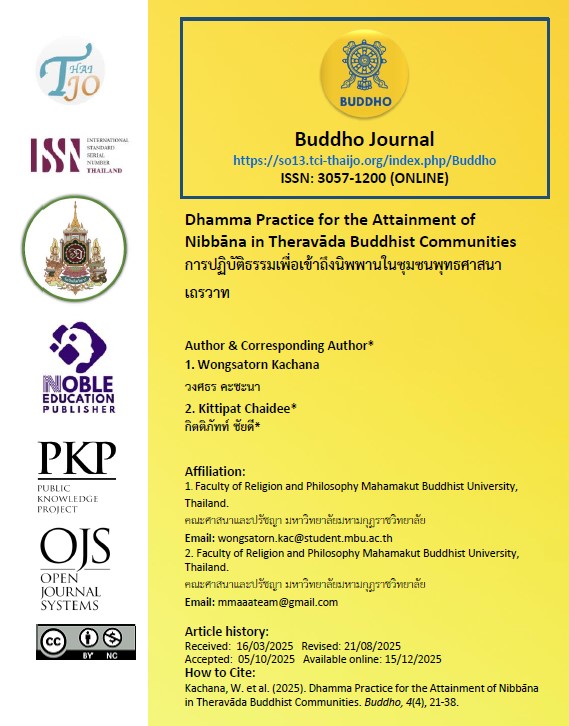
Dhamma Practice for the Attainment of Nibbāna in Theravāda Buddhist Communities
Keywords:
Nibbāna, Theravāda Buddhism, Dhamma Practice, Renunciation of Saṅkhāra, Cessation of SufferingAbstract
This research aims to analyze and synthesize the approaches to Dhamma practice within Theravāda communities that strive toward the attainment of Nibbāna. The study employs documentary research methods, drawing from the Tipiṭaka, commentarial texts, relevant academic research, and scholarly articles. The Theravāda approach to Dhamma practice emphasizes the observance of moral precepts (sīla), the cultivation of meditative concentration (samādhi), and the development of wisdom (paññā) through the framework of the Noble Eightfold Path. This path serves as the foundational mechanism for the gradual eradication of craving (taṇhā) and defilements (kilesa), which are the root causes of suffering (dukkha).
In this research, the researcher has compiled and analyzed relevant textual sources concerning the concept of Nibbāna in Theravāda Buddhism, with a focus on providing a comprehensive understanding of the practice-oriented process that enables practitioners to liberate themselves from the cycle of birth and death (saṃsāra) and attain Nibbāna—the ultimate goal of Theravāda Buddhism.
The findings indicate that consistent and dedicated Dhamma practice, particularly with an emphasis on the abandonment of craving and defilements, not only results in inner tranquility and mental purification but also enhances one’s insight into the nature of suffering and the impermanence of worldly phenomena. Furthermore, the research highlights the potential applicability of these practices in contemporary society to foster well-being and communal harmony. This study, therefore, holds significance both in reinforcing rigorous Dhamma practice within Theravāda communities and in providing a foundation for future research aimed at refining meditative training and mental development in alignment with modern social contexts.
References
มหามกุฏราชวิทยาลัย. (พ.ศ. 2539). พระไตรปิฎก: มหาวรรค เล่ม 1. กรุงเทพฯ: สำนักพิมพ์มหามกุฏราชวิทยาลัย.
มหามกุฏราชวิทยาลัย. (พ.ศ. 2539). พระไตรปิฎก: อังคุตตรนิกาย เล่ม 2. กรุงเทพฯ: สำนักพิมพ์มหามกุฏราชวิทยาลัย.
Analayo. (2012). Meditation and mindfulness in early Buddhist texts. Windhorse Publications.
Bodhi, B. (2000). The connected discourses of the Buddha: A translation of the Samyutta Nikaya. Wisdom Publications.
Bodhi, B. (2005). In the Buddha's words: An anthology of discourses from the Pali Canon. Wisdom Publications.
Chambers, T. (2010). Mindfulness in contemporary practice: Guidance for modern practitioners. Routledge.
Chiesa, A., & Serretti, A. (2009). Mindfulness-based stress reduction for stress management in healthy people: A review and meta-analysis. Journal of Alternative and Complementary Medicine, 15(5), 593–600.
Gethin, R. (1998). The foundations of Buddhism. Oxford: Oxford University Press.
Goleman, D., & Davidson, R. J. (2017). Altered traits: Science reveals how meditation changes your mind, brain, and body. Avery.
Harvey, P. (2013). An introduction to Buddhism: Teachings, history and practices (2nd ed.). Cambridge: Cambridge University Press.
Kabat-Zinn, J. (2003). Mindfulness-based interventions in context: Past, present, and future. Clinical Psychology: Science and Practice, 10(2), 144–156.
McMahan, D. L. (2008). The making of Buddhist modernism. Oxford University Press.
Ñāṇamoli, B. (Trans.). (1996). The middle length discourses of the Buddha: A translation of the Majjhima Nikāya. Boston: Wisdom Publications.
Ñāṇamoli, B., & Bodhi, B. (1995). The middle length discourses of the Buddha: A translation of the Majjhima Nikaya. Wisdom Publications.
Nyanaponika Thera. (1996). The heart of Buddhist meditation. York Beach, ME: Samuel Weiser.
Rahula, W. (1974). What the Buddha taught (Rev. ed.). New York: Grove Press.
Shonin, E., Van Gordon, W., & Griffiths, M. D. (2014). Mindfulness and Buddhism: Conceptual and empirical considerations. Mindfulness, 5(4), 385–388.
Thera, N. (1999). The teachings of the Buddha. Buddhist Publication Society.
Trainor, K. (2010). Buddhism: The illustrated guide. Oxford University Press.
Trainor, K. (2021). Contemporary Theravāda meditation practices and social adaptation. Journal of Buddhist Studies, 18(2), 45–68.
Wallace, B. A., & Shapiro, S. L. (2006). Mental balance and well-being: Building bridges between Buddhism and Western psychology. American Psychologist, 61(7), 690–701.
Wilson, J. (2014). Mindful America: Meditation and the mutual transformation of Buddhist meditation and American culture. Oxford University Press.
Additional Files
Published
How to Cite
Issue
Section
License
Copyright (c) 2025 Buddho

This work is licensed under a Creative Commons Attribution-NonCommercial-NoDerivatives 4.0 International License.