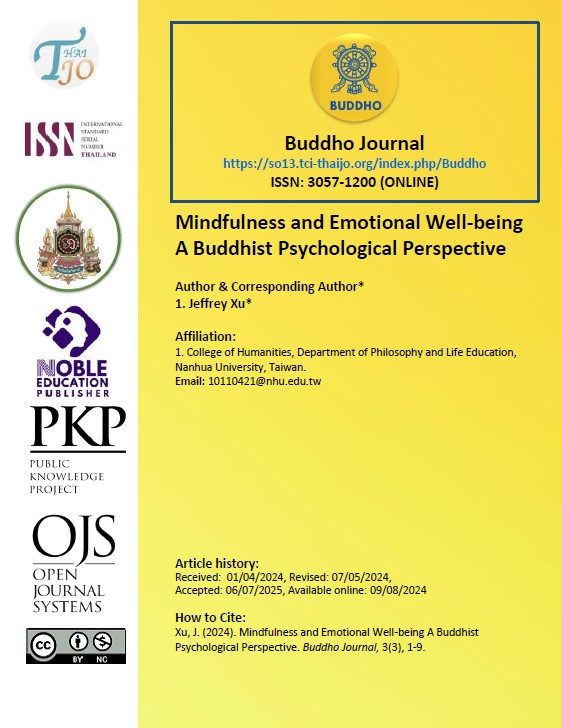
Mindfulness and Emotional Well-being A Buddhist Psychological Perspective
Keywords:
Mindfulness, Emotional Well-being, Buddhist Psychological PerspectiveAbstract
Mindfulness has become a widely studied psychological practice, offering significant benefits for emotional regulation, stress reduction, and psychological resilience. Rooted in Buddhist psychology, mindfulness encourages present-moment awareness and non-reactivity, promoting emotional stability and reducing distress. Mindfulness-based interventions (MBIs) have been shown to effectively enhance emotional regulation, particularly in individuals experiencing anxiety and depression. Furthermore, mindfulness plays a key role in reducing stress by addressing attachment and aversion, contributing to improved psychological well-being. Neuroscientific studies support its effectiveness by showing reduced brain activity associated with stress responses. Additionally, mindfulness fosters resilience by enhancing cognitive flexibility and self-regulation, helping individuals adapt to adversity. While mindfulness has been widely integrated into contemporary psychology, its deeper philosophical roots in Buddhism are often overlooked. This study emphasizes the need to integrate Buddhist philosophical principles with modern psychological frameworks, providing a more holistic approach to mental health that encompasses both psychological well-being and spiritual growth.
References
Bodhi, B. (2011). Mindfulness: The path to the deathless. Buddhist Publication Society.
Bodhi, B. (2011). The noble eightfold path: Way to the end of suffering. Pariyatti Publishing.
Creswell, J. D., & Lindsay, E. K. (2014). How does mindfulness training affect health? A mindfulness stress buffering account. Current Directions in Psychological Science, 23(6), 401-407.
Davidson, R. J., & McEwen, B. S. (2012). Social influences on neuroplasticity: Stress and interventions to promote well-being. Nature Neuroscience, 15(5), 689-695.
Gethin, R. (2015). Buddhist conceptualizations of mindfulness. Contemporary Buddhism, 16(1), 35-45.
Gethin, R. (2015). Buddhist conceptualizations of mindfulness. In Current Opinion in Psychology, 3, 54-57.
Gu, J., Strauss, C., Bond, R., & Cavanagh, K. (2015). How do mindfulness-based interventions work? Clinical Psychology Review, 37, 1-12.
Harvey, P. (2018). An introduction to Buddhism: Teachings, history, and practices (2nd ed.). Cambridge University Press.
Hölzel, B. K., Lazar, S. W., Gard, T., Schuman-Olivier, Z., Vago, D. R., & Ott, U. (2011). How does mindfulness meditation work? Proposing mechanisms of action from a conceptual and neural perspective. Perspectives on Psychological Science, 6(6), 537-559.
Kabat-Zinn, J. (2015). Mindfulness for beginners: Reclaiming the present moment—and your life. Sounds True.
Kornfield, J. (2017). The wise heart: A guide to the universal teachings of Buddhist psychology. Bantam Books.
Neff, K. D. (2011). Self-compassion, self-esteem, and well-being. Social and Personality Psychology Compass, 5(1), 1-12.
Shapiro, S. L., Astin, J. A., Bishop, S. R., & Cordova, M. (2005). Mindfulness-based stress reduction for health care professionals: Results from a randomized trial. International Journal of Stress Management, 12(2), 164-176.
Tang, Y. Y., Hölzel, B. K., & Posner, M. I. (2015). The neuroscience of mindfulness meditation. Nature Reviews Neuroscience, 16(4), 213-225.
Williams, J. M. G., & Kabat-Zinn, J. (2013). Mindfulness: Diverse perspectives on its meaning, origins, and applications. Routledge.
Zeidan, F., Johnson, S. K., Diamond, B. J., David, Z., & Goolkasian, P. (2010). Mindfulness meditation improves cognition: Evidence of brief mental training. Consciousness and Cognition, 19(2), 597-605.
Additional Files
Published
How to Cite
Issue
Section
License
Copyright (c) 2024 Buddho

This work is licensed under a Creative Commons Attribution-NonCommercial-NoDerivatives 4.0 International License.