การพัฒนาทักษะการรับมือกับการถูกกลั่นแกล้งของนักเรียนที่มีความต้องการพิเศษโดยใช้วิดีโอปฏิสัมพันธ์ร่วมกับบทบาทสมมติ
คำสำคัญ:
การรับมือกับการถูกกลั่นแกล้ง, วิดีโอปฏิสัมพันธ์, บทบาทสมมติ, นักเรียนที่มีความต้องการพิเศษบทคัดย่อ
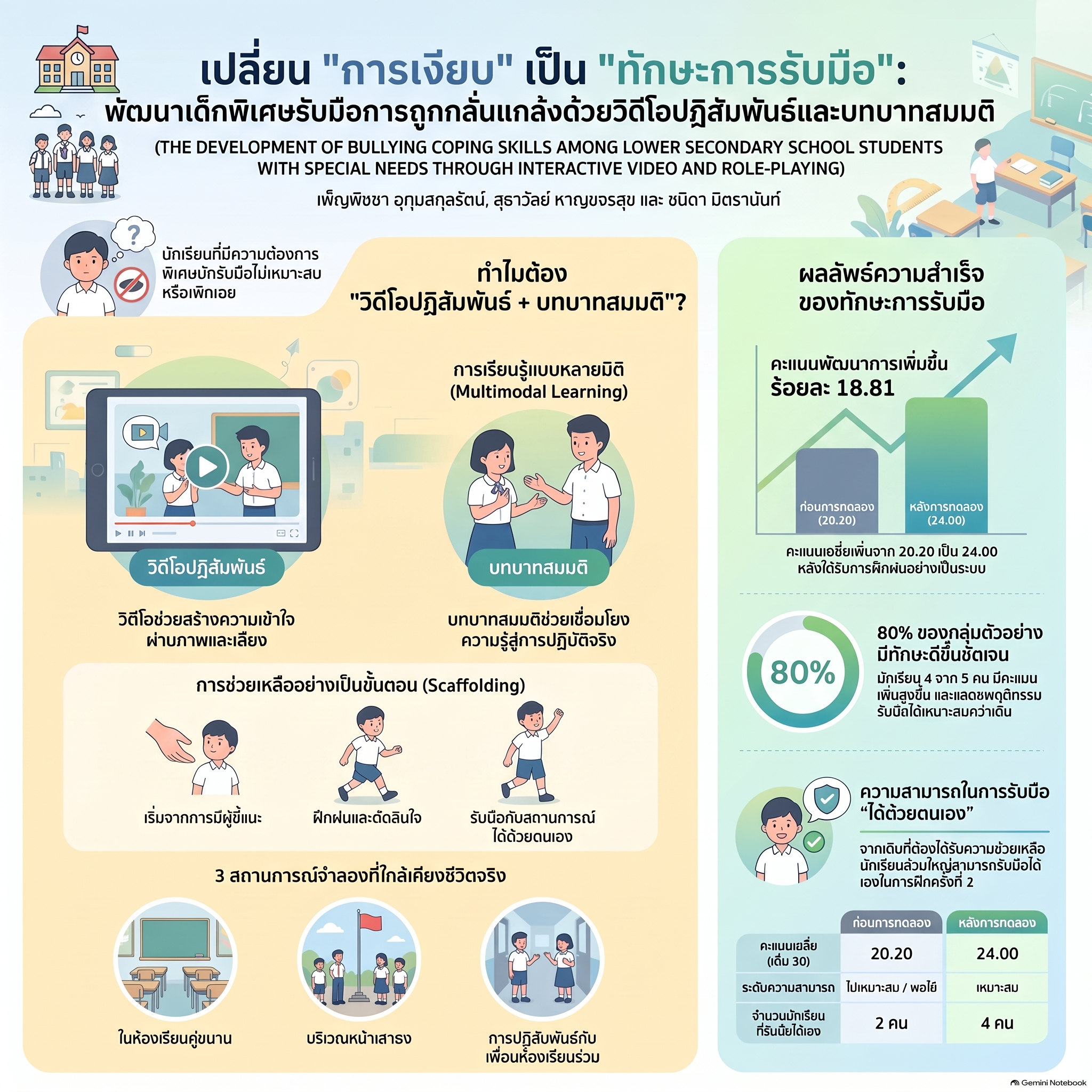
การวิจัยครั้งนี้มีวัตถุประสงค์เพื่อเปรียบเทียบความสามารถในการรับมือกับการถูกกลั่นแกล้งของนักเรียนที่มีความต้องการพิเศษระดับชั้นมัธยมศึกษาตอนต้นก่อนและหลังได้รับการสอนด้วยวิดีโอปฏิสัมพันธ์ร่วมกับบทบาทสมมติ ใช้แบบแผนการวิจัยกึ่งทดลองแบบกลุ่มเดียววัดก่อนและหลังการทดลอง (One-Group Pretest–Posttest Design) กลุ่มตัวอย่างเป็นนักเรียนที่มีความต้องการพิเศษจำนวน 5 คน ซึ่งกำลังศึกษาอยู่ในห้องเรียนคู่ขนาน โรงเรียนสังกัดสำนักงานเขตพื้นที่การศึกษามัธยมศึกษากรุงเทพมหานครเขต 1 ได้มาโดยการคัดเลือกแบบเจาะจง เครื่องมือที่ใช้ในการวิจัย ได้แก่ แผนการจัดการเรียนรู้ วิดีโอปฏิสัมพันธ์ แบบประเมินการรับมือกับการถูกกลั่นแกล้ง และแบบวัดเชิงสถานการณ์การรับมือกับการถูกกลั่นแกล้ง วิเคราะห์ข้อมูลโดยใช้สถิติเชิงพรรณนา ได้แก่ ค่าเฉลี่ย ร้อยละ และการวิเคราะห์เนื้อหา ผลการวิจัยพบว่า หลังการทดลองนักเรียนส่วนใหญ่มีพัฒนาการด้านการรับมือกับการถูกกลั่นแกล้ง โดยคะแนนเฉลี่ยเพิ่มขึ้นจาก 20.20 เป็น 24.00 คิดเป็นร้อยละ 18.81 นักเรียนจำนวน 4 คนมีคะแนนเพิ่มขึ้น และ 1 คนมีคะแนนคงที่ นอกจากนี้ ผลการสังเกตพฤติกรรมระหว่างเรียนพบว่า นักเรียนสามารถรับมือกับสถานการณ์จำลองได้ด้วยตนเองเพิ่มขึ้นอย่างต่อเนื่อง สะท้อนให้เห็นว่าการสอนด้วยวิดีโอปฏิสัมพันธ์ร่วมกับบทบาทสมมติสามารถส่งเสริมทักษะการรับมือกับการถูกกลั่นแกล้งของนักเรียนที่มีความต้องการพิเศษได้
เอกสารอ้างอิง
มูลนิธิศูนย์พิทักษ์สิทธิเด็ก. (2566). คู่มือกิจกรรม (สำหรับนักเรียน) การป้องกันการรังแกกันในโรงเรียน.
วิฐารณ บุญสิทธิ, จริยา ทะรักษา, นภัทร สิทธาโนมัย, พัฏ โรจน์มหามงคล, วัลลภ อัจสริยะสงห์, ศศิธร จันทรทิณ, สุรีย์ลักษณ์ สุจริตพงศ์, และอัจฉรา เสถียรกิจการชัย. (2565). จิตเวชศาสตร์เด็กและวัยรุ่นในเวชปฏิบัติ Child and adolescent psychiatry in clinical practice (พิมพ์ครั้งที่ 2). พี.เอ.ลีฟวิ่ง.
ศูนย์สุขภาพจิตที่ 7. (2561). เผยเด็กไทยถูกรังแกในโรงเรียนเป็นอันดับ 2 ของโลก. https://mhc7.dmh.go.th/12/10/2018/6736/
สกล วรเจริญศรี. (2559). การข่มเหงรังแก. สารานุกรมศึกษาศาสตร์, 51, 15-16.
สุฮัยณี อาหวัง. (2563). ศึกษาผลกระทบจากพฤติกรรมการกลั่นแกล้งของนักเรียนในจังหวัดปัตตานี [วิทยานิพนธ์ศิลปศาสตรบัณฑิต, มหาวิทยาลัยสงขลานครินทร์ วิทยาเขตปัตตานี].
Álvarez-Guerrero, G., García-Carrión, R., Khalfaoui, A., Santiago-Garabieta, M., & Flecha, R. (2023). Preventing bullying of students with special educational needs through dialogic gatherings: A case study in elementary education. Humanities and Social Sciences Communications, 10(1), 1-9.
Anggadewi, B. E. T. (2017). Scaffolding: How it works for students with learning difficulties. The 2017 International Conference on Research in Education, 210-218. https://www.scribd.com/document/642669437/Scaffolding-How-It-Works-for-Students-with-Learning-Difficulties-pdf
Carruthers, S., Charman, T., Leadbitter, K., Ellis, C., Taylor, L., Moore, H., Taylor, C., James, K., Balabanovska, M., & Langhorne, S. (2025). Generalisation of social communication skills by autistic children during play-based assessments across home, school and an unfamiliar research setting. Journal of Autism and Developmental Disorders, 55(7), 2203-2216.
Donohoe, P. (2020). Teachers using role-play to prevent bullying. International Journal of Bullying Prevention, 2(4), 264-279.
Haerawan, H., Cale, W., & Barroso, U. (2024). The effectiveness of interactive videos in increasing student engagement in online learning. Journal of Computer Science Advancements, 2(5), 244-258.
Kim, M. S. (2017). Multimodal modeling activities with special needs students in an informal learning context: Vygotsky revisited. Eurasia Journal of Mathematics, Science and Technology Education, 13(6), 2133-2154.
Laugeson, E. F. (2020). The Program for the Education and Enrichment of Relational Skills (PEERS). In Social skills across the life span: Theory, assessment, and intervention (pp. 255-273). Elsevier Academic Press. https://doi.org/10.1016/B978-0-12-817752-5.00013-5
Olweus, D. (1994). Bullying at school: Basic facts and effects of a school based intervention program. Journal of Child Psychology and Psychiatry, 35(7), 1171-1190.
Saad, M. A. E. (2018). The effectiveness of a life skills training based on the response to intervention model on improving functional communication skills in children with autism. Psycho-Educational Research Reviews, 7(3), 56–61.
Thue, D., Bulitko, V., Spetch, M., & Wasylishen, E. (2007). Interactive storytelling: A player modelling approach. Proceedings of the AAAI Conference on Artificial Intelligence and Interactive Digital Entertainment.
Van Herwegen, J., Masterman, T., Dockrell, J., Marshall, C., Gordon, R., & Thomas, M. S. (2026). Raising educational outcomes for students with special educational needs and disabilities: A systematic review and meta‐analysis. Review of Education, 14(1), Article e70127.
ดาวน์โหลด
เผยแพร่แล้ว
รูปแบบการอ้างอิง
ฉบับ
ประเภทบทความ
หมวดหมู่
สัญญาอนุญาต
ลิขสิทธิ์ (c) 2026 คณะศึกษาศาสตร์ มหาวิทยาลัยศรีนครินทรวิโรฒ

อนุญาตภายใต้เงื่อนไข Creative Commons Attribution-NonCommercial-NoDerivatives 4.0 International License.


