
THE DEVELOPMENT OF AN AUGMENTED REALITY EDUCATIONAL BOARD GAME BASED ON COOPERATIVE LEARNING TO ENHANCE COMPUTATIONAL THINKING SKILLS FOR GRADE 1 STUDENTS
Keywords:
Educational Board Game, Augmented Reality, Cooperative Learning, Computational Thinking SkillsAbstract
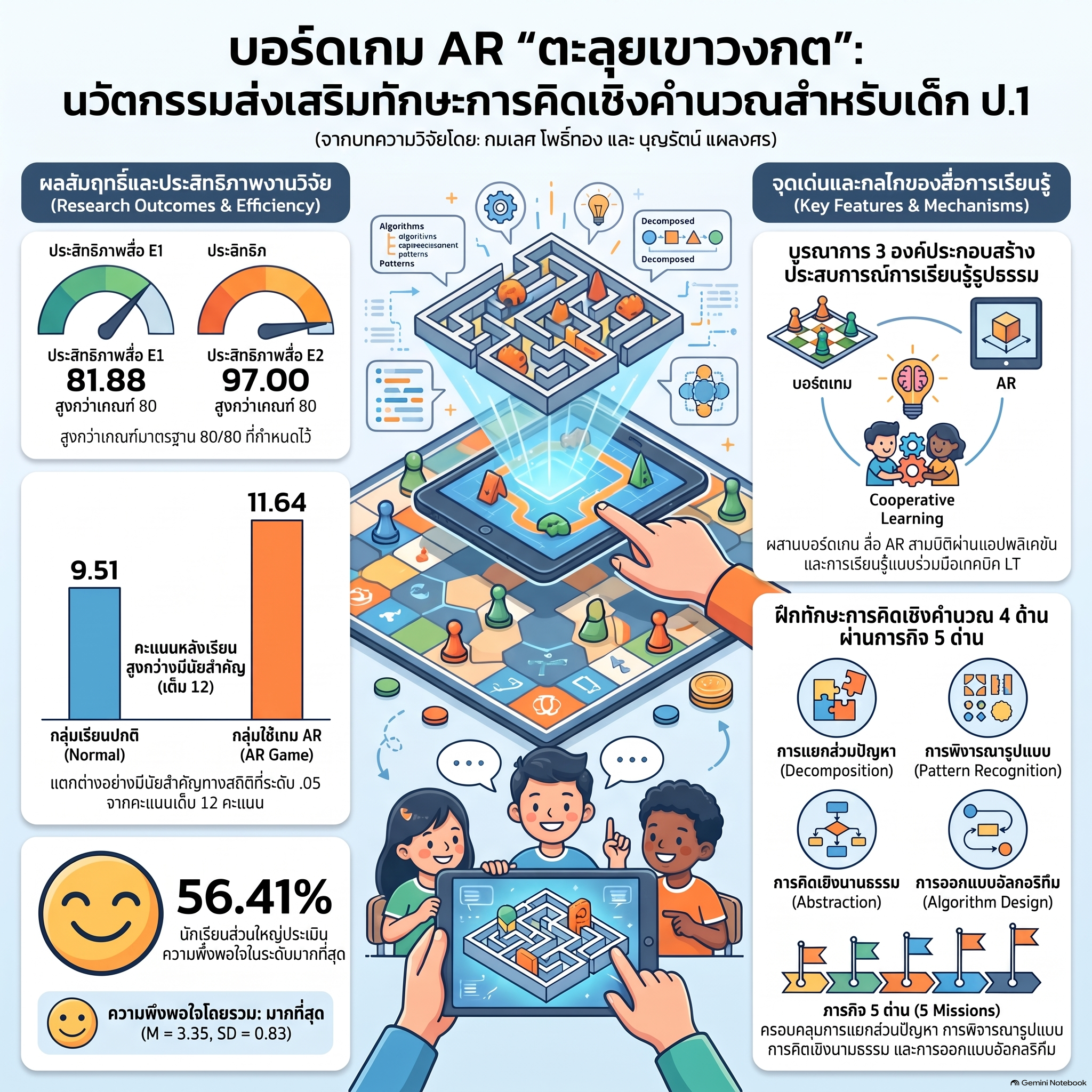
This research aimed to 1) develop and evaluate the efficiency of an augmented reality educational board game based on cooperative learning concepts to promote computational thinking skills for Grade 1 students, 2) compare pre- and post-learning computational thinking skills of the experimental and control groups, and between groups post-learning, and 3) investigate the satisfaction of students toward the augmented reality educational board game. The sample consisted of 78 Grade 1 students from the Demonstration School of Kasetsart University, Educational Research and Development Center, during the second semester of the 2025 academic year, divided into an experimental group of 39 students and a control group of 39 students using cluster random sampling. The research instruments included the augmented reality educational board game, lesson plans for teachers, a computational thinking skills assessment form, and an activity and satisfaction record form. Statistical methods used for data analysis were mean, standard deviation, Paired Samples t-test, and Independent Samples t-test. The results revealed that 1) the developed board game was evaluated by experts at the highest quality level, with an efficiency of 81.88/97.00, exceeding the specified criterion, 2) the experimental group had significantly higher computational thinking skills after learning than before, and significantly higher than the control group at the .05 level, and 3) the experimental group's overall satisfaction toward the augmented reality educational board game was at the highest level (M = 3.35, SD = 0.83).
References
ฉัตรพงศ์ ชูแสงนิล. (2563). แนวคิดเชิงคำนวณ. สถาบันส่งเสริมการสอนวิทยาศาสตร์และเทคโนโลยี. https://www.scimath.org/lesson-technology/item/10560-2019-08-28-02-43-20
ณัฐนันท์ ภัทรวินเดโชพัฒน์, นารา อำศรี, และบุญรัตน์ แผลงศร. (2566). การประยุกต์ใช้เทคโนโลยีความจริงเสริมในห้องเรียน สำหรับนักเรียนระดับชั้นประถมศึกษา. วารสารเทคโนโลยีสารสนเทศ มจพ., 19(1), 87–93. https://ph01.tci-thaijo.org/index.php/IT_Journal/article/view/253264
ทรรศนภรณ์ เทพภูธร, สัญชัย พัฒนสิทธิ์, และไพฑูรย์ ศรีฟ้า. (2565). การพัฒนาบอร์ดเกมการศึกษาความเป็นจริงเสริมสำหรับการเรียนรู้โดยใช้เกมเป็นฐานเพื่อส่งเสริมผลสัมฤทธิ์ทางการเรียนของนักเรียนชั้นประถมศึกษาปีที่ 3. วารสารการวัดผลการศึกษา สำนักทดสอบทางการศึกษาและจิตวิทยา, 39(105), 64–75. https://so06.tci-thaijo.org/index.php/JEMEPTB/article/view/257488
ธนวุฒิ ปัญญาพูนผล, เกศินี ครุณาสวัสดิ์, และกิตติศักดิ์ ลักษณา. (2565). การพัฒนาการจัดการเรียนรู้สังคมศึกษาโดยใช้บอร์ดเกม SOC civilization เพื่อเสริมสร้างความเป็นพลเมืองและความสามารถในการทำงานเป็นทีมของนักเรียนชั้นประถมศึกษาปีที่ 5. วารสารวิชาการศึกษาศาสตร์ ศรีนครินทรวิโรฒ, 23(2), 123–136. https://so13.tci-thaijo.org/index.php/SWU_JEd/article/view/2809
เปรมฤดี ศรีสะอาด, ชนะชัย อวนวัง, และทัชชวัฒน์ เหล่าสุวรรณ. (2567). การพัฒนากิจกรรมการเรียนรู้แบบร่วมมือเทคนิค LT เรื่อง กระบวนการประชาธิปไตยชั้นประถมศึกษาปีที่ 3. วารสารสังคมศาสตร์ปัญญาพัฒน์, 6(2), 385–394. https://so06.tci-thaijo.org/index.php/JSSP/article/view/271225
ยืน ภู่วรวรรณ, และพันธุ์ เปี่ยมสง่า. (2563). การศึกษาไทยในยุคดิจิทัล. สำนักพิมพ์จุฬาลงกรณ์มหาวิทยาลัย.
ไสว ฟักขาว. (2544). หลักการสอนสำหรับการเป็นครูมืออาชีพ. สถาบันราชภัฏจันทรเกษม.
อธิติยา สร้างนอก, จักรพงษ์ วารี, และกฤษฎิ์สรัล รุจิรภัชปณัยภพ. (2566). การพัฒนาการเรียนรู้เรื่องวัสดุและอุปกรณ์พื้นฐานสำหรับนักเรียนชั้นมัธยมศึกษาปีที่ 4 ผ่านเทคโนโลยีความเป็นจริงเสริมร่วมกับการเรียนรู้แบบร่วมมือ. วารสารพัฒนาภูมิปัญญาทางการศึกษา มหาวิทยาลัยราชภัฏสุรินทร์, 1(2), 15–30. https://so08.tci-thaijo.org/index.php/JEDU-SRRU/article/view/2284
Gee, J. P. (2003). What video games have to teach us about learning and literacy. Palgrave Macmillan. https://doi.org/10.5040/9781628927924.ch-013
Huang, S.-Y., Tarng, W., & Ou, K.-L. (2023). Effectiveness of AR board game on computational thinking and programming skills for elementary school students. Systems, 11(1), Article 25. https://doi.org/10.3390/systems11010025
Johnson, D. W., & Johnson, R. T. (2009). An educational psychology success story: Social interdependence theory and cooperative learning. Educational Researcher, 38(5), 365–379. https://doi.org/10.3102/0013189X09339057
Machuqueiro, F., & Piedade, J. (2024). Game on: A journey into computational thinking with modern board games in Portuguese primary education. Education Sciences, 14(11), Article 1182. https://doi.org/10.3390/educsci14111182
McHugh, M. L. (2012). Interrater reliability: The kappa statistic. Biochemia Medica, 22(3), 276–282. https://pmc.ncbi.nlm.nih.gov/articles/PMC3900052/ https://doi.org/10.11613/bm.2012.031
National Society of High School Scholars. (2025). 5 benefits of collaborative learning strategies: How to get started. https://www.nshss.org/resources/blog/blog-posts/5-benefits-of-collaborative-learning-strategies-how-to-get-started/
Piaget, J. (1972). The psychology of the child. Basic Books.
Villa, L. (2021). Growth & development: 6 to 12 years (school age). Children's Hospital of Orange County. https://choc.org/ages-stages/6-to-12-years/
Vygotsky, L. S. (1978). Mind in society: The development of higher psychological processes. Harvard University Press.
Downloads
Published
How to Cite
Issue
Section
Categories
License
Copyright (c) 2026 Faculty of Education, Srinakharinwirot university

This work is licensed under a Creative Commons Attribution-NonCommercial-NoDerivatives 4.0 International License.


