
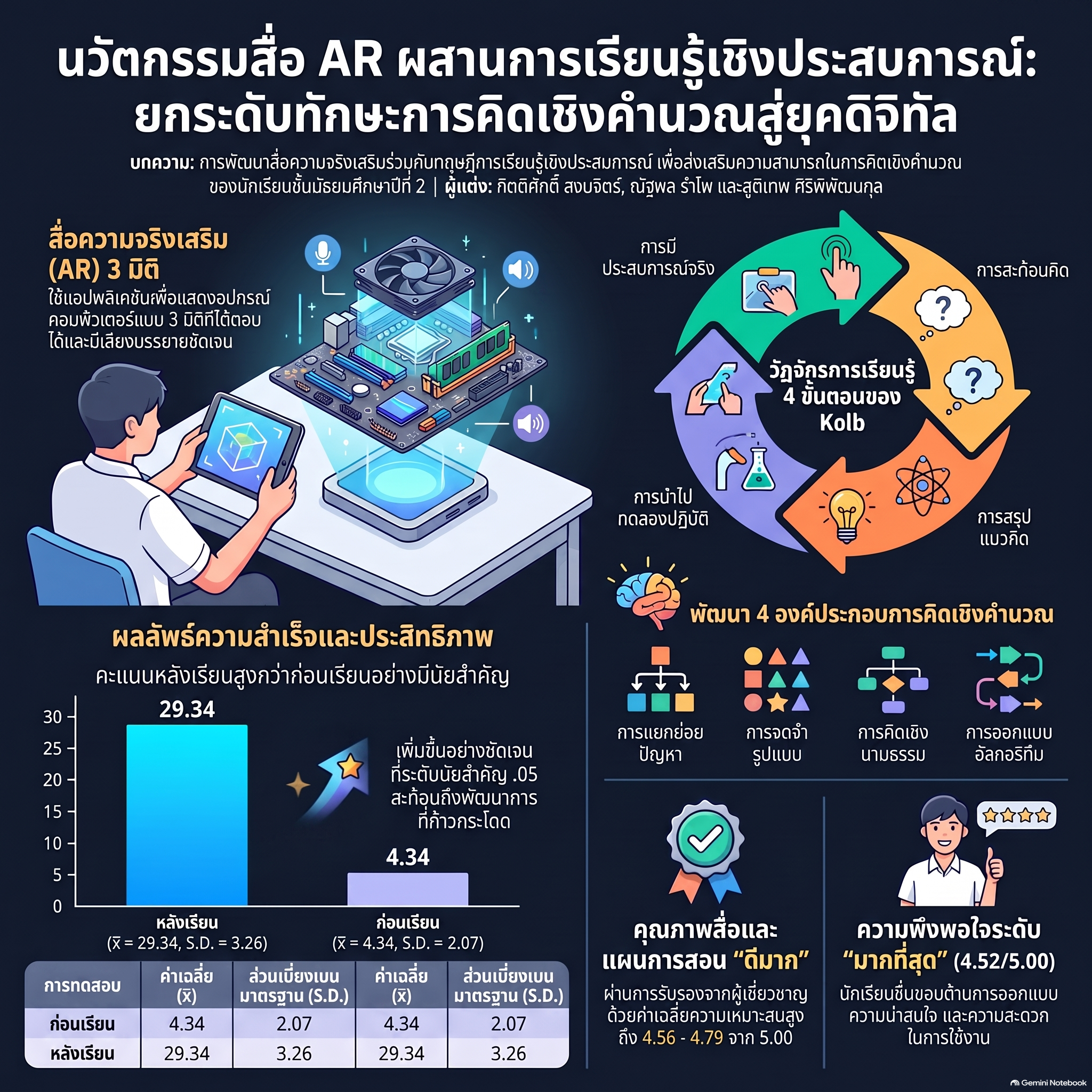
การพัฒนาสื่อความจริงเสริมร่วมกับทฤษฎีการเรียนรู้เชิงประสบการณ์ เพื่อส่งเสริมความสามารถในการคิดเชิงคำนวณของนักเรียน ชั้นมัธยมศึกษาปีที่ 2 โรงเรียนสาธิตแห่งมหาวิทยาลัยเกษตรศาสตร์ โครงการการศึกษาพหุภาษา ศูนย์วิจัยและพัฒนาการศึกษา
คำสำคัญ:
สื่อความจริงเสริม, การเรียนรู้เชิงประสบการณ์, การคิดเชิงคำนวณบทคัดย่อ
การวิจัยครั้งนี้มีวัตถุประสงค์เพื่อ 1) ออกแบบและพัฒนาสื่อการเรียนรู้ความจริงเสริม ร่วมกับทฤษฎีการเรียนรู้เชิงประสบการณ์ ในรายวิชาวิทยาการคำนวณ เรื่องหลักการทำงานของระบบคอมพิวเตอร์ ชั้นมัธยมศึกษาปีที่ 2 2) พัฒนาความสามารถในการคิดเชิงคำนวณ เรื่องหลักการทำงานของระบบคอมพิวเตอร์ ชั้นมัธยมศึกษาปีที่ 2 3) เพื่อศึกษาความพึงพอใจของผู้ต่อใช้สื่อการเรียนรู้ความจริงเสริม ร่วมกับทฤษฎีการเรียนรู้เชิงประสบการณ์ กลุ่มตัวอย่างได้แก่ นักเรียนชั้นมัธยมศึกษาปีที่ 2 โรงเรียนสาธิตแห่งมหาวิทยาลัยเกษตรศาสตร์ โครงการการศึกษาพหุภาษา ศูนย์วิจัยและพัฒนาการศึกษา จำนวน 32 คนที่ได้มาจากการสุ่มอย่างง่าย เครื่องมือที่ใช้ในการวิจัย ได้แก่ 1) สื่อความจริงเสริม 2) แบบวัดความสามารถในการคิดเชิงคำนวณ และ 3) แบบสอบถามความพึงพอใจ ผลวิจัยพบว่า 1) ผลการประเมินคุณภาพสื่อการเรียนรู้ความจริงเสริม ร่วมกับทฤษฎีการเรียนรู้เชิงประสบการณ์ พบว่า คุณภาพของสื่อความจริงเสริมที่สร้างขึ้นอยู่ในระดับดีมาก 2) ผลการเปรียบเทียบความสามารถในการคิดเชิงคำนวณก่อนเรียนและหลังเรียนของนักเรียนที่เรียนด้วยสื่อการเรียนรู้ความจริงเสริม ร่วมกับทฤษฎีการเรียนรู้เชิงประสบการณ์ คะแนนหลังเรียนของนักเรียนสูงกว่าคะแนนก่อนเรียน อย่างมีนัยสำคัญทางสถิติที่ระดับ .05 3) ผลการประเมินความพึงพอใจของผู้เรียนหลังจากใช้สื่อการเรียนรู้ความจริงเสริม ความพึงพอใจอยู่ในระดับมากที่สุด
เอกสารอ้างอิง
ก้องเกียรติ หิรัญเกิด. (2568). การจัดกิจกรรมพัฒนาทักษะการคิดด้วยสื่อเทคโนโลยีความจริงเสริมของนักศึกษาระดับอุดมศึกษา. วารสารวิชาการวิทยาลัยสันตพล, 11(2), 203–209. https://so05.tci-thaijo.org/index.php/scaj/article/view/281460
ชัยยงค์ พรหมวงศ์. (2556). การทดสอบประสิทธิภาพสื่อหรือชุดการสอน. วารสารศิลปากรศึกษาศาสตร์วิจัย, 5(1), 7-20. https://so05.tci-thaijo.org/index.php/suedureasearchjournal/article/view/28419
ณัฐธิดา กัลยาประสิทธิ์. (2564). การพัฒนาการคิดเชิงคำนวณโดยใช้การจัดการเรียนรู้แบบปัญหาเป็นฐานตามแนวคิดสะเต็มศึกษา เรื่องโมเมนตัมและการชน สำหรับนักเรียนชั้นมัธยมศึกษาปีที่ 4 [วิทยานิพนธ์ปริญญามหาบัณฑิต, มหาวิทยาลัยนเรศวร]. http://nuir.lib.nu.ac.th/dspace/handle/123456789/4066
นันทิชา พึ่งพวก. (2567). การพัฒนาแนวคิดเชิงคำนวณด้วยการจัดการเรียนรู้โดยปัญหาเป็นฐานในรายวิชาวิทยาการคำนวณของนักเรียนชั้นมัธยมศึกษาปีที่ 2. วารสาร มจร อุบลปริทรรศน์, 9(1), 1175-1186. https://so06.tci-thaijo.org/index.php/mcjou/article/view/272813
เบญนภา พัฒนาพิภัทร. (2565). การพัฒนาสื่อการเรียนรู้เพื่อส่งเสริมกระบวนการคิดเชิงสร้างสรรค์ในการสร้างสื่อยุคดิจิทัลร่วมกับเทคโนโลยีความเป็นจริงเสริม (AR). Silpakorn University e-Journal, 42(1), 15-30. https://doi.org/10.14456/sujthai.2022.2
ยุภารัตน์ พืชสิงห์. (2564). การพัฒนาความสามารถในการคิดเชิงคำนวณโดยใช้การจัดกิจกรรมการเรียนรู้แบบใช้ปัญหาเป็นฐานร่วมกับเครือข่ายสังคมออนไลน์ของนักเรียนชั้นมัธยมศึกษาปีที่ 2 [วิทยานิพนธ์ปริญญามหาบัณฑิต, มหาวิทยาลัยมหาสารคาม]. https://khoon.msu.ac.th/_dir/fulltext/2022/06/Yuparat_Puechsing64.pdf
วทัญญู สารปรัง. (2567). การศึกษาความต้องการพัฒนาความสามารถในการคิดเชิงคำนวณในรายวิชาวิทยาการคำนวณ สำหรับนักเรียนชั้นมัธยมศึกษาตอนต้น. วารสารมนุษยศาสตร์ สังคมศาสตร์และนวัตกรรม มหาวิทยาลัยกาฬสินธุ์, 3(1), 52-67. https://doi.nrct.go.th/admin/doc/doc_648227.pdf
สถาบันส่งเสริมการสอนวิทยาศาสตร์และเทคโนโลยี กระทรวงศึกษาธิการ. (2561, 24 พฤษภาคม). คู่มือการใช้หลักสูตรเทคโนโลยี (วิทยาการคำนวณ) กลุ่มสาระการเรียนรู้วิทยาศาสตร์ (ฉบับปรับปรุง พ.ศ.2560) ระดับประถมศึกษา และมัธยมศึกษา. https://www.scimath.org/ebook-technology/item/8376-2560-2551
สุทธาภา มาประกอบ. (2565). การจัดการเรียนรู้เชิงประสบการณ์เพื่อพัฒนาสมรรถนะผู้ประกอบการดิจิทัลโดยทุนทางวัฒนธรรมเมืองลับแลของนักเรียนชั้นมัธยมศึกษาตอนปลาย [วิทยานิพนธ์ปริญญามหาบัณฑิต, มหาวิทยาลัยนเรศวร]. https://nuir.lib.nu.ac.th/dspace/bitstream/123456789/5653/3/SutapaMapragorp.pdf
อนันต์ญา กิจเรืองศรี. (2568). การพัฒนาสื่อการเรียนรู้ความจริงเสริมตามทฤษฎีการสร้างองค์ความรู้ด้วยตนเองเพื่อส่งเสริมทักษะการคิดเชิงคำนวณ เรื่อง การเขียนโปรแกรมโดยใช้เหตุผลเชิงตรรกะ สำหรับนักเรียนชั้นประถมศึกษาปีที่ 5. วารสารเทคโนโลยีและสื่อสารการศึกษา คณะศึกษาศาสตร์ มหาวิทยาลัยมหาสารคาม, 8(27), 19-30. https://so02.tci-thaijo.org/index.php/etcedumsujournal/article/view/279243/186370
Ahdhianto, E. (2025). Augmented reality as a game changer in experiential learning: Exploring its role cultural education for elementary schools. Journal of Pedagogical Research, 9(1), 296-313. https://doi.org/10.33902/JPR.202533573
Azuma, R. T. (1997). A survey of augmented reality. Presence: Teleoperators and Virtual Environments, 6(4), 355-385.
Bers, M., Strawhacker, A., & Sullivan, A. (2022). The state of the field of computational thinking in early childhood education (OECD Education Working Papers, No. 274). OECD Publishing. https://doi.org/10.1787/3354387a-en
Billinghurst, M., & Duenser, A. (2012). Augmented reality in the classroom. Computer, 45, 56-63. https://doi.org/10.1109/MC.2012.111
Dunleavy, M., & Dede, C. (2014). Augmented reality teaching and learning. In Handbook of research on educational communications and technology (pp. 735-745). Springer.
Kolb, D. (1984). Experiential learning: Experience as the source of learning and development. Prentice-Hall.
Molenda, M. (2003). In search of the elusive ADDIE model. Performance Improvement, 42(5), 34-36. https://doi.org/10.1002/pfi.4930420508
Wing, J. (2006). Computational thinking. Communications of the ACM, 49, 33-35. https://doi.org/10.1145/1118178.1118215
ดาวน์โหลด
เผยแพร่แล้ว
รูปแบบการอ้างอิง
ฉบับ
ประเภทบทความ
หมวดหมู่
สัญญาอนุญาต
ลิขสิทธิ์ (c) 2026 คณะศึกษาศาสตร์ มหาวิทยาลัยศรีนครินทรวิโรฒ

อนุญาตภายใต้เงื่อนไข Creative Commons Attribution-NonCommercial-NoDerivatives 4.0 International License.


