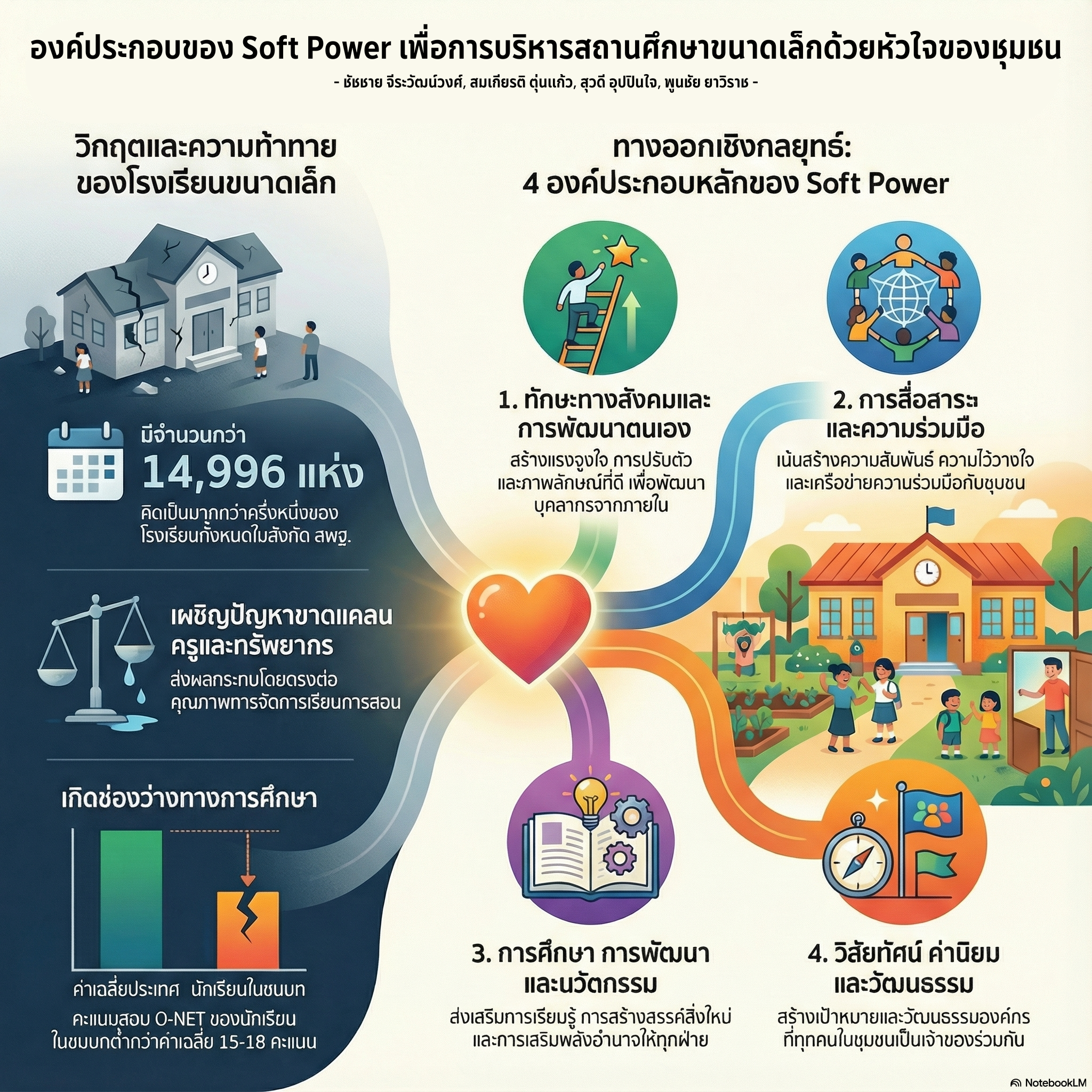
องค์ประกอบของ Soft Power เพื่อการบริหารสถานศึกษาขนาดเล็กด้วยหัวใจของชุมชน
คำสำคัญ:
Soft Power, องค์ประกอบ, การบริหารสถานศึกษา , โรงเรียนขนาดเล็กบทคัดย่อ
ภายใต้การเปลี่ยนแปลงในโลกยุคปัญญาประดิษฐ์ที่ก้าวล้ำทางเทคโนโลยี โรงเรียนขนาดเล็กของไทยเผชิญความท้าทายด้านบุคลากรและทรัพยากรอย่างรุนแรง ส่งผลต่อคุณภาพการเรียนรู้และความเหลื่อมล้ำทางการศึกษา บทความวิชาการนี้จึงนำเสนอแนวคิด “Soft Power” เป็นทางเลือกเชิงกลยุทธ์สำหรับการบริหารโรงเรียนขนาดเล็ก โดยมีจุดมุ่งหมายเพื่อสังเคราะห์ความหมาย และบริบทของ Soft Power ในมิติการศึกษา รวบรวมองค์ประกอบ Soft Power 4 ด้าน รวม 17 องค์ประกอบ ได้แก่ (1) ทักษะทางสังคมและการพัฒนาตนเอง (2) การสื่อสารและความร่วมมือ (3) การศึกษาและนวัตกรรม และ (4) วิสัยทัศน์-ค่านิยม-วัฒนธรรม พร้อมทั้งเชื่อมโยงองค์ประกอบเหล่านี้กับภาคปฏิบัติของผู้บริหารสถานศึกษา และเสนอแนวทางประยุกต์ใช้เพื่อแก้ปัญหาการขาดแคลนครูอย่างยั่งยืน บทความฉบับนี้นำเสนอวิธีที่ผู้บริหารสถานศึกษาสามารถนำองค์ประกอบ Soft Power ไปใช้ในการสร้างแรงจูงใจ รักษาครู และเพิ่มคุณภาพการเรียนรู้ และนำเสนอข้อเสนอเชิงนโยบายเพื่อสนับสนุนการปรับใช้ Soft Power ในบริบทการศึกษาของไทย เพื่อเติมเต็มช่องว่างเชิงทฤษฎีและเสนอแนวทางปฏิบัติที่เป็นรูปธรรมสำหรับผู้บริหารโรงเรียนขนาดเล็กและผู้กำหนดนโยบายการศึกษา
เอกสารอ้างอิง
ประเวศ เวชชะ. (2568). Reboot Thai School – ปฏิวัติการศึกษาไทย. สืบค้น 5 มิถุนายน 2568, จาก https://www.facebook.com/RebootThaiSchool?locale=th_TH
วรกมล วงษ์สถาปนาเลิศ, สุดสวาท จันทร์ดำ, และ สุดารัตน์ เทพพิมล. (2567). อำนาจละมุน (soft power) กับจุดขายทางวัฒนธรรมไทย. วารสารศิลปการจัดการ, 8(1), 382–398. สืบค้นจาก https://so02.tci-thaijo.org/index.php/jam/article/view/268763
วรพล ศรีเทพ. (2568). Soft power นวัตกรรมการเรียนรู้สร้างสรรค์ในยุคการศึกษา 5.0 ผ่านกระบวนการ SHOW Process สำหรับพัฒนาการจัดกิจกรรมผู้เรียน. วารสารสังคมวิจัยและพัฒนา, 7(1), 138–152. สืบค้นจาก https://so05.tci-thaijo.org/index.php/socjr/article/view/xxxxxx
สถาบันทดสอบทางการศึกษาแห่งชาติ (องค์การมหาชน). (2564). สรุปผลการทดสอบทางการศึกษาระดับชาติขั้นพื้นฐาน (O-NET) ชั้นมัธยมศึกษาปีที่ 6 ปีการศึกษา 2563. สืบค้นจาก https://www.niets.or.th/th/catalog/view/3262
สำนักงานคณะกรรมการการศึกษาขั้นพื้นฐาน. (2564). รายงานสภาพปัญหาการจัดการศึกษาในโรงเรียนขนาดเล็ก. กรุงเทพฯ: กระทรวงศึกษาธิการ.
สำนักงานคณะกรรมการการศึกษาขั้นพื้นฐาน. (2566). รายงานสถานภาพโรงเรียนขนาดเล็กประเทศไทย. กรุงเทพฯ: กระทรวงศึกษาธิการ.
สำนักนโยบายและแผน สำนักงานคณะกรรมการการศึกษาขั้นพื้นฐาน. (2568). สถิติข้อมูลทางการศึกษา ปีการศึกษา 2568/1. กรุงเทพฯ: สำนักงานคณะกรรมการการศึกษาขั้นพื้นฐาน.
สุวิทย์ เมษินทรีย์. (2560). การสร้างพลังชุมชนเพื่อการพัฒนาอย่างยั่งยืน. กรุงเทพฯ: สำนักพิมพ์มหาวิทยาลัยธรรมศาสตร์.
Bertalanffy, L. von. (1968). General system theory: Foundations, development, applications. New York, NY: George Braziller.
Hargreaves, A., & Fullan, M. (2014). Professional capital: Transforming teaching in every school. New York, NY: Teachers College Press.
Hofstede, G. (1980). Culture’s consequences: International differences in work-related values. Beverly Hills, CA: Sage.
Lewin, K. (1974). Field theory in social science. New York, NY: Harper & Row. (Original work published 1951)
McClory, J. (2012). The new persuaders III: A 2012 global ranking of soft power. London, England: Institute for Government. Retrieved from https://www.instituteforgovernment.org.uk/publications/new-persuaders-iii
Nye, J. S. (2004). Soft power: The means to success in world politics. New York, NY: PublicAffairs.
OECD. (2024). Education at a glance 2024: OECD indicators. Paris, France: OECD Publishing. Retrieved from https://www.oecd.org/education/education-at-a-glance
Putnam, R. D. (2000). Bowling alone: The collapse and revival of American community. New York, NY: Simon & Schuster.
Rappaport, J. (1981). In praise of paradox: A social policy of empowerment over prevention. American Journal of Community Psychology, 9(1), 1–25. doi:10.1007/BF00896357
Said, E. W. (1978). Orientalism. New York, NY: Vintage Books.
World Bank. (2022). World development report 2022: Finance for an equitable recovery. Washington, DC: World Bank. doi:10.1596/978-1-4648-1818-9
ดาวน์โหลด
เผยแพร่แล้ว
รูปแบบการอ้างอิง
ฉบับ
ประเภทบทความ
หมวดหมู่
สัญญาอนุญาต
ลิขสิทธิ์ (c) 2025 คณะศึกษาศาสตร์ มหาวิทยาลัยศรีนครินทรวิโรฒ

อนุญาตภายใต้เงื่อนไข Creative Commons Attribution-NonCommercial-NoDerivatives 4.0 International License.


