อิทธิพลของบุคลิกภาพห้าองค์ประกอบและกรอบแนวคิดแบบเติบโต ที่มีต่อความยืดหยุ่นทางจิตใจของนักศึกษาครู มหาวิทยาลัยราชภัฏบ้านสมเด็จเจ้าพระยา
คำสำคัญ:
ความยืดหยุ่นทางจิตใจ, บุคลิกภาพห้าองค์ประกอบ, กรอบแนวคิดแบบเติบโตบทคัดย่อ
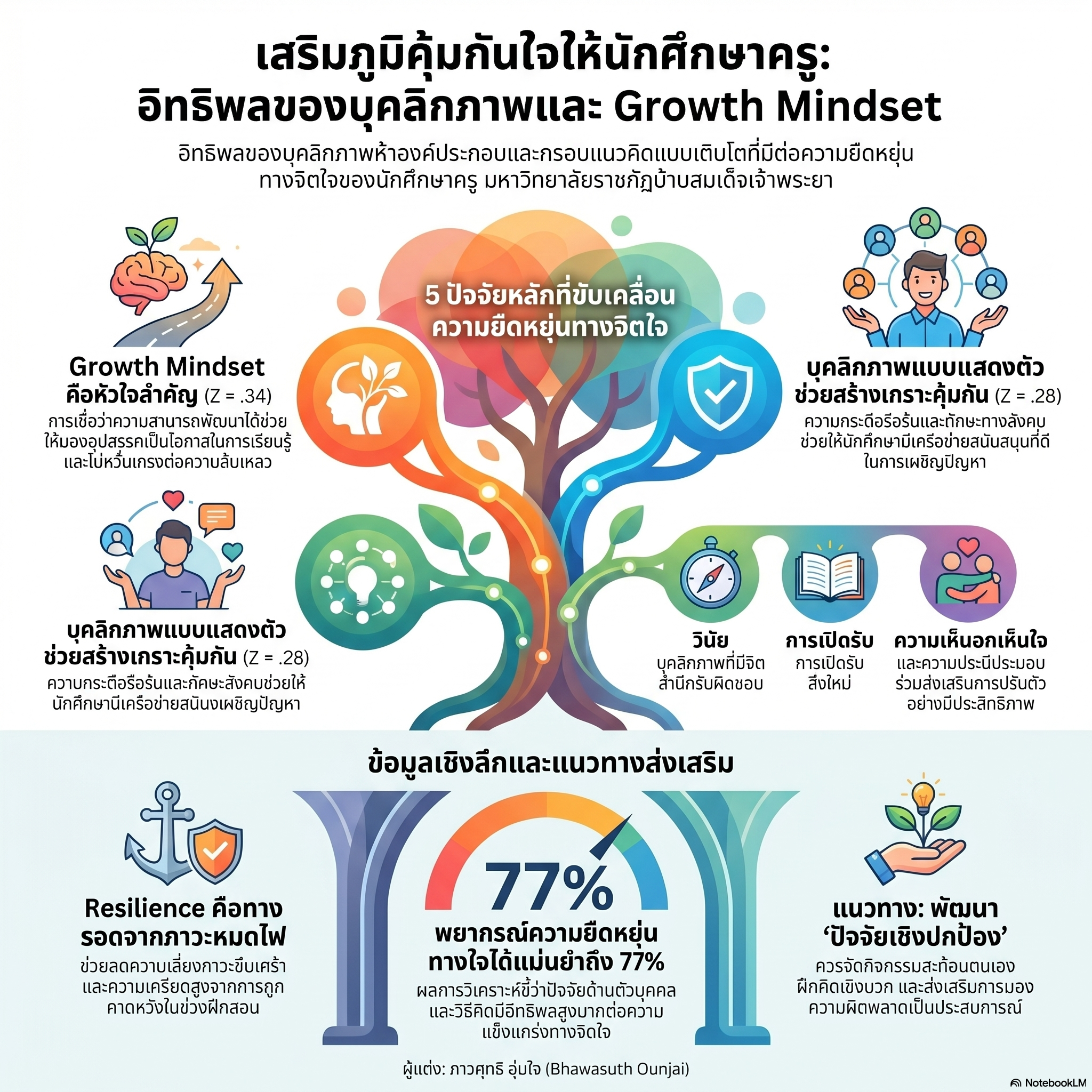
การวิจัยนี้มีวัตถุประสงค์เพื่อศึกษาอิทธิพลของบุคลิกภาพห้าองค์ประกอบและกรอบแนวคิดแบบเติบโตที่มีต่อความยืดหยุ่นทางจิตใจของนักศึกษาครู มหาวิทยาลัยราชภัฏบ้านสมเด็จเจ้าพระยา กลุ่มตัวอย่างในงานวิจัยนี้ คือนักศึกษาครูจากคณะครุศาสตร์จำนวน 430 คน โดยใช้วิธีการสุ่มตัวอย่างแบบชั้นภูมิ เครื่องมือในการเก็บรวบรวมข้อมูลคือแบบวัดบุคลิกภาพห้าองค์ประกอบ แบบวัดกรอบความคิดแบบเติบโตและแบบวัดความยืดหยุ่นทางจิตใจ โดยแบบวัดมีค่าความเชื่อมั่นระหว่าง .815 -.958 วิเคราะห์ข้อมูลด้วย ค่าสัมประสิทธิ์สหสัมพันธ์แบบเพียร์สันและการวิเคราะห์การถดถอยพหุคูณแบบขั้นตอน ผลการวิจัย พบว่า กรอบความคิดแบบเติบโต (X6) บุคลิกภาพแสดงตัว (X2) บุคลิกภาพเปิดรับประสบการณ์ (X3) บุคลิกภาพประนีประนอม (X4 ) และบุคลิกภาพมีจิตสำนึกรับผิดชอบ (X5) มีอิทธิพลต่อความยืดหยุ่นทางจิตใจของนักศึกษาครู มหาวิทยาลัยราชภัฏบ้านสมเด็จเจ้าพระยา อย่างมีนัยสำคัญทางสถิติที่ระดับ .01 โดยตัวแปรร่วมกันพยากรณ์ความยืดหยุ่นทางจิตใจได้ร้อยละ 77 สามารถสร้างสมการการพยากรณ์ในรูปคะแนนมาตรฐานได้ดังนี้ Z = .34X6 + .28X2 + .16X5 + .16X3 + .09X4
เอกสารอ้างอิง
กมลชนก ชุมทัพ. (2565). การศึกษากระบวนการเกิดความยืดหยุ่นทางจิตใจจากการเผชิญวิกฤตเศรษฐกิจในอดีต: กรณีศึกษาผู้ประกอบการวิสาหกิจรายย่อยในกรุงเทพมหานครและปริมณฑลที่ประสบภาวะวิกฤตเศรษฐกิจซ้ำ. บัณฑิตวิทยาลัย มหาวิทยาลัยศรีนครินทรวิโรฒ.
กรมสุขภาพจิต. (2567). ข้อมูลการประเมินสุขภาพจิตคนไทย. สืบค้นเมื่อ 3 พฤษภาคม 2567 จาก https://checkin.dmh.go.th/dashboards
ชนิตา รุ่งเรือง, & เสรี ชัดแช้ม. (2559). กรอบแนวคิดเติบโต: แนวทางใหม่แห่งการพัฒนาศักยภาพมนุษย์. วารสารวิทยาการวิจัยและวิทยาการปัญญา, 14(1), 1–13.
ฐิติกาญจน์ บุญรักษา อินทาปัจ. (2563). กรอบมโนทัศน์ความเครียดจากการฝึกประสบการณ์วิชาชีพครูในนักศึกษาวิชาชีพครู. วารสารครุศาสตร์สาร จุฬาลงกรณ์มหาวิทยาลัย, 48(4), 147–165. https://doi.org/10.58837/CHULA.EDUCU.48.4.9
ธนะดี สุริยะจันทร์หอม. (2561). การพัฒนารูปแบบการเสริมสร้างโกรว์ธมายด์เซตสำหรับนักศึกษาหลักสูตรวิชาชีพครู (ดุษฎีนิพนธ์ปรัชญาดุษฎีบัณฑิต, มหาวิทยาลัยมหาสารคาม).
ทรงศักดิ์ ภูสีอ่อน. (2561). การประยุกต์ใช้ SPSS วิเคราะห์ข้อมูลงานวิจัย (พิมพ์ครั้งที่ 8). มหาสารคาม: ตักสิลาการพิมพ์.
นิธิพัฒน์ เมฆขจร. (2564). ความยืดหยุ่นทางจิตใจ (Resilience): วิถีใหม่ของการเสริมสร้างพลังใจเพื่อการเผชิญวิกฤตชีวิตในยุคปัจจุบัน. วารสารจิตวิทยา มหาวิทยาลัยเกษมบัณฑิต, 11(2), 1–9.
นันทิมา นาคาพงศ์. (2559). การสร้างและพัฒนาแบบวัดบุคลิกภาพห้าองค์ประกอบหลักสำหรับนักเรียนชั้นประถมศึกษาและมัธยมศึกษา. สถาบันทดสอบทางการศึกษาแห่งชาติ (องค์การมหาชน).
รุ่งฤดี กล้าหาญ, อมรา วิสูตรานุกูล, พนัส จันทร์เปล่ง, & ธัญชนก เพ็งเพราะ. (2565). การพัฒนาแบบวัดบุคลิกภาพห้าองค์ประกอบสำหรับนิสิตปริญญาตรีชั้นปีที่ 4 มหาวิทยาลัยศรีนครินทรวิโรฒ. วารสารการวัดผลการศึกษา มหาวิทยาลัยมหาสารคาม, 28(2), 187–205.
ศรีสุดา วนาลีสิน, วิลาวรรณ คริสต์รักษา, & ไผโรส มูฮัมหมัดสกุล. (2562). ความแข็งแกร่งในชีวิตของนักเรียนมัธยมศึกษาในจังหวัดภาคใต้ตอนล่าง. วารสารการพยาบาลจิตเวชและสุขภาพจิต, 33(1), 111–127.
Ang, W. H., Lau, T., Cheng, L. J., Chew, H. S. J., Tan, J., Shorey, S., & Lau, Y. (2022). Effectiveness of resilience interventions for higher education students: A meta-analysis and metaregression. Journal of Educational Psychology. https://doi.org/10.1037/edu0000719
Boullion, G. Q., Sisk, V. F., & Dweck, C. S. (2021). Growth mindsets and academic outcomes: A meta-analytic synthesis. Psychological Bulletin, 147(3), 256–287.
Burke, K. J., Finch, J. S., Paton, D., & Ryan, M. (2006). Characterizing the resilient officer: Individual attributes at point of entry to policing. Traumatology, 12(3), 178–188. https://doi.org/10.1177/1534765606296531
Campbell-Sills, L., Cohan, S. L., & Stein, M. B. (2006). Relationship of resilience to personality, coping, and psychiatric symptoms in young adults. Behavior Research and Therapy, 44, 585–599. https://doi.org/10.1016/j.brat.2005.05.001
Costa, P. T., & McCrae, R. R. (1999). A five-factor theory of personality. In L. A. Pervin & O. P. John (Eds.), The five-factor model of personality: Theoretical perspectives (Vol. 2, pp. 51–87). New York: Guilford Press.
Dweck, C. S. (2006). Mindset: The new psychology of success. New York: Random House.
Dweck, C. S. (2017). The journey to children's mindsets—and beyond. Child Development Perspectives, 13(4), 225–230.
Ercan, H. (2017). The relationship between resilience and the Big Five personality traits in emerging adulthood. Eurasian Journal of Educational Research, 17(70), 83–103. https://dergipark.org.tr/en/pub/ejer/issue/42480/511718
Faul, F., Erdfelder, E., Buchner, A., & Lang, A. G. (2009). Statistical power analyses using G*Power 3.1: Tests for correlation and regression analyses. Behavior Research Methods, 41(4), 1149–1160. http://dx.doi.org/10.3758/BRM.41.4.1149
Fayombo, G. A. (2010). The relationship between personality traits and psychological resilience among the Caribbean adolescents. International Journal of Psychological Studies, 2(2), 105–116.
Findyartini, A., Greviana, N., Putera, A. M., et al. (2021). The relationships between resilience and student personal factors in an undergraduate medical program. BMC Medical Education, 21, 113. https://doi.org/10.1186/s12909-021-02547-5
Goleman, D. (1997). Emotional intelligence: Why it can matter more than IQ. New York: Bantam Books.
Grotberg, E. (1995). A guide to promoting resilience in children: Strengthening the human spirit. The Bernard van Leer Foundation.
Hähnchen, D. (2022). The relationship between extraversion and resilience during the Covid-19 pandemic among university students: Does cognitive restructuring partially mediate its association? University of Twente. (Thesis)
Havlik, E. J. (2018). Resilience in undergraduate students: The relation between personality, social support, and cortisol levels (Master’s thesis). University of Northern Iowa. https://scholarworks.uni.edu/etd/931
Kaya, S., Eryilmaz, N., & Yuksel, D. (2024). The effects of growth mindset and resilience on immigrant students’ PISA science achievement: The mediating role of attitudes toward school. SAGE Open, 14(1). https://doi.org/10.1177/21582440231225870
Khosbayar, A., Andrade, M. S., & Miller, R. M. (2022). The relationship between psychological resilience and the Big Five personality traits. International Management Review, 18(1), 4–11.
Matthews, G., & Deary, I. J. (1998). Personality traits. Cambridge: Cambridge University Press.
Mohammed, A. A., & Mostafa, A. A. (2015). Five factor personality traits and psychological resilience among secondary school students in Egypt. Psycho-Educational Research Reviews, 4(2), 3–9. https://perrjournal.com/index.php/perrjournal/article/view/325
Mohamud, G., Madderla, S. R., & Taqa, A. (2024). An investigation into the effects of personality traits and resilience on homesickness among international students. International Journal of All Research Education and Scientific Methods, 12(1), 966. https://doi.org/10.56025/IJARESM.2023.1201242970
Naidu, E., Paravati, E., & Gabriel, S. (2022). Staying happy even when staying 6 ft apart: The relationship between extroversion and social adaptability. Personality and Individual Differences, 190, 111549. https://doi.org/10.1016/j.paid.2022.111549
Oshio, A., Taku, K., Hirano, M., & Saeed, G. (2018). Resilience and Big Five personality traits: A meta-analysis. Personality and Individual Differences, 127, 54–60. https://doi.org/10.1016/j.paid.2018.01.048
Roberts, B. W., Walton, K. E., & Viechtbauer, W. (2006). Patterns of mean-level change in personality traits across the life course: A meta-analysis of longitudinal studies. Psychological Bulletin, 132(1), 1–25. https://doi.org/10.1037/0033-2909.132.1.1
Rutter, M. (1985). Resilience in the face of adversity: Protective factors and resistance to psychiatric disorder. The British Journal of Psychiatry, 147, 598–611. https://doi.org/10.1192/bjp.147.6.598
Sahni, S., Kumari, S., & Pachaury, P. (2021). Building emotional resilience with Big Five personality model against COVID-19 pandemic. FIIB Business Review, 10(1), 39–51. https://doi.org/10.1177/2319714520954559
Sharma, S., Sharma, M., & Sharma, L. (2021). Prediction of resilience based on personality traits of female adolescent students. Bioscience Biotechnology Research Communications, 14(4).
Singh, M., & Singh, S. (2022). Correlational study of personality traits with resilience and life satisfaction. Journal of Positive School Psychology, 6(10), 4537–4543. http://journalppw.com
Walker, K. A., & Jiang, X. (2022). An examination of the moderating role of growth mindset in the relation between social stress and externalizing behaviors among adolescents. Journal of Adolescence, 94, 69–80. https://doi.org/10.1002/jad.12006
Wang, D., Yuan, F., & Wang, Y. (2020). Growth mindset and academic achievement in Chinese adolescents: A moderated mediation model of reasoning ability and self-affirmation. Current Psychology, 41, 783–792. https://doi.org/10.1007/s12144-019-00597-z
Yeager, D. S., & Dweck, C. S. (2012). Mindsets that promote resilience: When students believe that personal characteristics can be developed. Educational Psychologist, 47(4), 302–314.
Zager Kocjan, G., Kavčič, T., & Avsec, A. (2021). Resilience matters: Explaining the association between personality and psychological functioning during the COVID-19 pandemic. International Journal of Clinical and Health Psychology, 21(1), Article 100198. https://doi.org/10.1016/j.ijchp.2020.08.002
Zhao, H., Xiong, J., Zhang, Z., & Qi, C. (2021). Growth mindset and college students' learning engagement during the COVID-19 pandemic: A serial mediation model. Frontiers in Psychology, 12, Article 621094. https://doi.org/10.3389/fpsyg.2021.621094
ดาวน์โหลด
เผยแพร่แล้ว
รูปแบบการอ้างอิง
ฉบับ
ประเภทบทความ
หมวดหมู่
สัญญาอนุญาต
ลิขสิทธิ์ (c) 2025 คณะศึกษาศาสตร์ มหาวิทยาลัยศรีนครินทรวิโรฒ

อนุญาตภายใต้เงื่อนไข Creative Commons Attribution-NonCommercial-NoDerivatives 4.0 International License.


