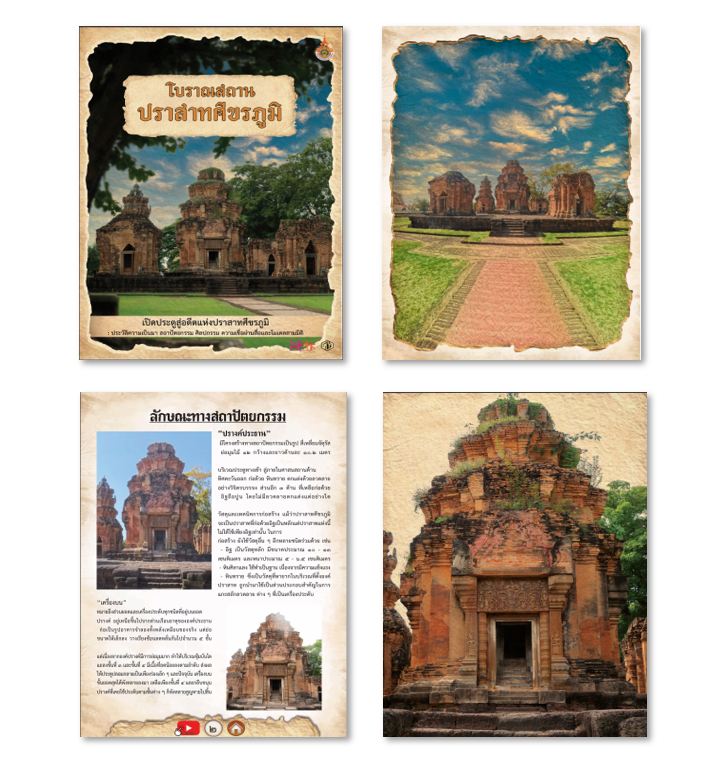
The Development of Interactive Media for Educating Prasat Sikhoraphum for Grade 9 Students at Sikhoraphum District, Surin
DOI:
https://doi.org/10.66854/ijdte.2025.e3283Keywords:
Interactive Media, Educating Prasat Sikhoraphum, Sikhoraphum DistrictAbstract
Introduction: This research aimed to to develop interactive media for educating Prasat Sikhoraphum for grade 9 students at Sikhoraphum sistrict, Surin; and to assess students’ satisfaction with the developed virtual interactive media.
Methodology: The sample group in this study consisted of 66 Grade 9 students from Yang Wittayakarn School in the academic year 2024, selected through purposive sampling. The research instruments included virtual interactive media for promoting learning about Prasat Sikhoraphum, a quality evaluation form, and a satisfaction evaluation questionnaire. Data was analyzed using basic statistical methods, including frequency, percentage, mean, and standard deviation.
Results: The research findings revealed that the results of the development of virtual interactive media for promoting learning about Prasat Sikhoraphum revealed that the media consisted of the following components: (1) a virtual interactive electronic book (e-book), (2) a poster, (3) video (VTR), and (4) a three-dimensional (3D) model that allows viewers to explore Prasat Sikhoraphum from all angles in a 360-degree view. The overall quality evaluation of the developed virtual interactive media was rated at a very good level, with a mean score of 4.52. In addition, the overall level of students’ satisfaction with the virtual interactive media was also rated as very good, with a mean score of 4.53.
Downloads
References
Chaikhunpol, N., Thongrin, S., & Towkeaw, W. (2018). Development of an Interactive Communication Model for Chiang Mai Cultural Tourism via Mobile Devices. Chiang Mai University Journal of Humanities, 18(2), 176–212. (In Thai)
Jairassamee, J., & Saitong, P. (2023). Guidelines for Using a 360-Degree Interactive Media Approach to Promote Archaeology Tourism in Case Study of Sikhoraphum Castle at Surin Province. Journal of Local Governance and Innovation, 7(2), 111–126. https://doi.org/10.14456/jlgisrru.2023.27. (In Thai)
Kankam, P., Kotchasarn, T., & Ruangkitwat, I. (2022). Application of Geo-Informatics Technology for Modeling of Art and Cultural Sites in Wiang Chiang Saen Sub-district, Chiang Saen District, Chiang Rai Province. Rajabhat Rambhai Barni Research Journal, 16(3), 187-196. (In Thai)
Maprasom, W., Potisarn, N., Jairassamee, J., Potisarn, W., Chaithongsri, A., Yasaka, P., Meesawatdikul, W., Suksam, J., & Wathanti, S. (2021). Effect of Using Digital Media with Augmented Reality Technology for Creating Tourism Route Map of Khmer Civilization in four South Isan Provinces: Nakhon Ratchasima, Buriram, Surin and Sisaket. Journal of Yala Rajabhat University , 16(2), 161–170. (In Thai)
Ngamchindavongse, K. (2017). Designing Presentation System for Archeological Information by Augmented Reality to Physical Model: A Case of Prasat Khao Lon, Sakaew. [Master's Thesis, Thammasat University]. TU Digital Collections. https://digital.library.tu.ac.th/tu_dc/frontend/Info/item/dc:141914. (In Thai)
Ponpukdee, S. (2022). The Results of Learning Management on Language and Culture, Foreign Language Department Using Toontastic 3D Application for Prathomsuksa 3 Students. Journal of Pacific Institute of Management Science (Humanities and Social Sciences), 8(2), 581-594. (In Thai)
Pumla, K. (2012). The Meaning and Historical Background of Ancient Monuments. http://golftom.blogspot.com/2012/11/blog-post.html. (In Thai)
Ruangchewin, P. (n.d.). Influence and Relationships of the Lintels of Prasat Sikhoraphum. https://www.academia.edu/6017826/ทับหลังปราสาทศรีขรภูมิ. (In Thai)
Salaemad, Y. (2024). Developing Creative Thinking Skills with Augmented Reality (AR) Technology on Human Rights for Grade 9 Students. Journal of Graduate Saket Review, 9(3), 239–251. (In Thai)