Utilizing Mobile and Multimedia Technology to Enhance Online Learning Skills
DOI:
https://doi.org/10.66854/ijdte.2026.e2489Keywords:
Mobile Technology, Multimedia Technology, Learning Skill, Digital Learning, Technology Integration, Education InnovationAbstract
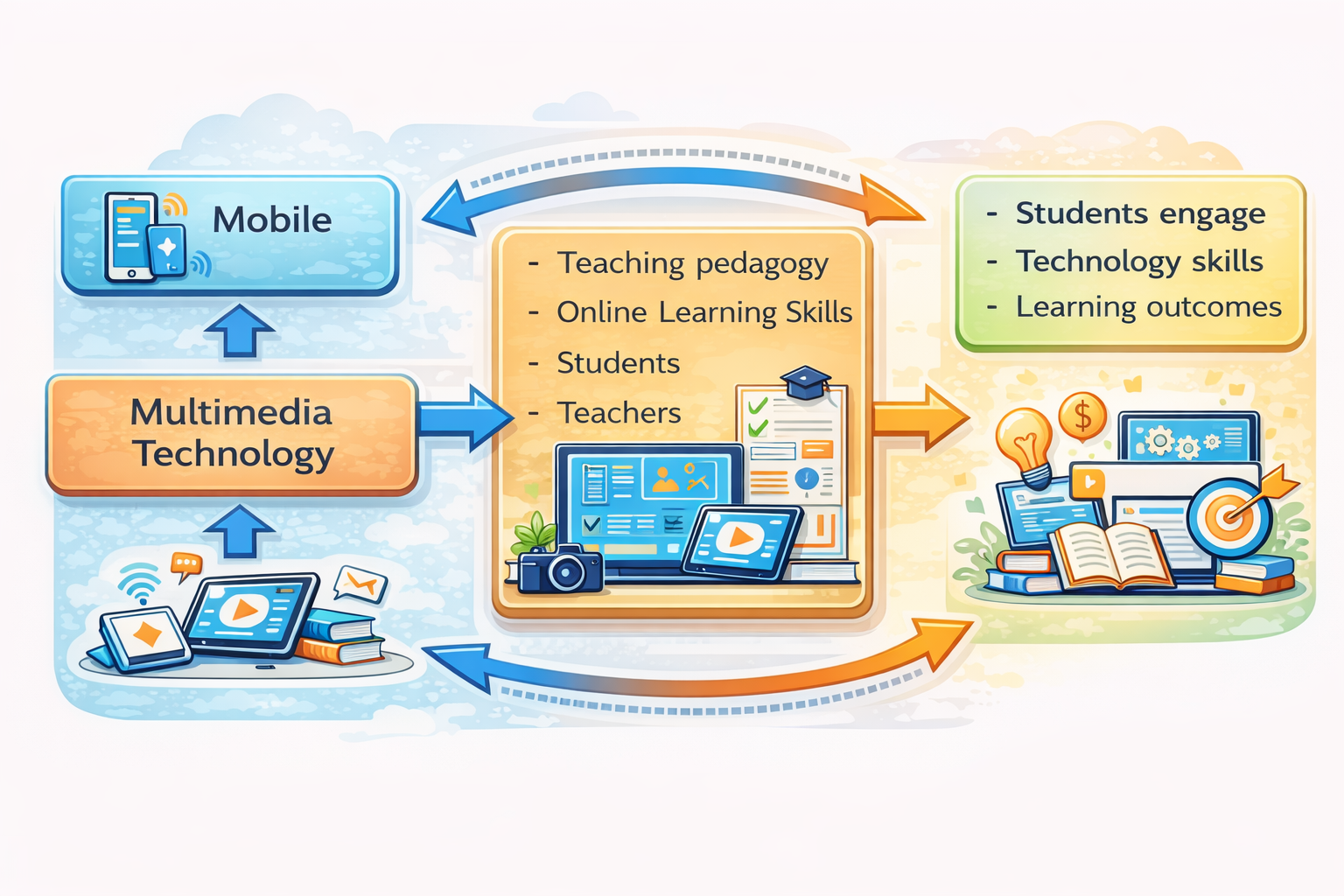
Introduction: This article proposes utilizing mobile and multimedia technology to enhance online learning skills are to show the information of utilizing mobile technology for education, and to investigate the effect of integrating mobile and multimedia technology to improve online learning skills.
Contribution: The result showed that Mobile and multimedia technologies can effectively enhance students’ online learning skills in the 21st century. They support the development of analytical thinking, critical thinking, creativity, communication, and lifelong learning. With the integration of modern technologies, learners gain greater opportunities to access educational resources anytime and anywhere through mobile and multimedia tools.
Downloads
References
Anuyahong, B., & Pucharoen, N. (2023). Exploring the Effectiveness of Mobile Learning Technologies in Enhancing Student Engagement and Learning Outcomes. International Journal of Emerging Technologies in Learning, 18(18), 50–63. https://doi.org/10.3991/ijet.v18i18.40445. DOI: https://doi.org/10.3991/ijet.v18i18.40445
Ashar, M., Kamdi, W., & Kurniawan, D. T. (2021). Professional Skills Development Through the Network Learning Community Using an Online Learning Platform. International Journal of Interactive Mobile Technologies, 15(12), 202. https://doi.org/10.3991/ijim.v15i12.21587. DOI: https://doi.org/10.3991/ijim.v15i12.21587
Barth, K. M., & Ciobanu, N. R. (2021, January 18-19). Integration of Multimedia Technologies in the Teaching-Learning-Assessment Process. 8th International Conference on Education and Education of Social Sciences, 153-158. https://doi.org/10.51508/intcess.202196. DOI: https://doi.org/10.51508/intcess.202196
Celeste, R. J., & Osias, N. (2024). Challenges and Implementation of Technology Integration: Basis for Enhanced Instructional Program. American Journal of Arts and Human Science, 3(2), 106–130. https://doi.org/10.54536/ajahs.v3i2.2656. DOI: https://doi.org/10.54536/ajahs.v3i2.2656
Chambers, D. (2020). Assistive Technology Supporting Inclusive Education: Existing and Emerging Trends. In Chambers, D. (Eds.), Assistive Technology to Support Inclusive Education (1–16). Emerald Publishing Limited. https://doi.org/10.1108/S1479-363620200000014001. DOI: https://doi.org/10.1108/S1479-363620200000014001
Chen, L. (2025). A Virtual Simulation-Based Perspective on Intercultural Communication in Language Learning. Journal of Combinatorial Mathematics and Combinatorial Computing, 124, 333–349. https://doi.org/10.61091/jcmcc124-23. DOI: https://doi.org/10.61091/jcmcc124-23
Chigbu, B. I., Ngwevu, V., & Jojo, A. (2023). The Effectiveness of Innovative Pedagogy in the Industry 4.0: Educational Ecosystem Perspective. Social Sciences & Humanities Open, 7(1), 100419. https://doi.org/10.1016/j.ssaho.2023.100419. DOI: https://doi.org/10.1016/j.ssaho.2023.100419
Culajara, C. J., Culajara, J. P. M., Portos, O., & Villapando, M. K. (2023). Technological Capabilities of Teachers in Using Digital Modality. ASEAN Journal of Education, 8(2), 1–8.
Gaziyeva, D., & Azadillayeva, O. (2024). The Role of Multimedia in Language Learning. American Journal of Philological Sciences, 4(12), 22–25. https://doi.org/10.37547/ajps/volume04issue12-04. DOI: https://doi.org/10.37547/ajps/Volume04Issue12-04
GEM Report UNESCO. (2023a). Technology in Education: A Case Study on Indonesia. GEM Report UNESCO. https://doi.org/10.54676/WJMY7427 DOI: https://doi.org/10.54676/WJMY7427
GEM Report UNESCO. (2023b). Technology in Education: A Case Study on Lao People’s Democratic Republic. GEM Report UNESCO. https://doi.org/10.54676/IKWQ7828 DOI: https://doi.org/10.54676/IKWQ7828
Godsk, M., & Møller, K. L. (2025). Engaging Students in Higher Education with Educational Technology. Education and Information Technologies, 30(3), 2941–2976. https://doi.org/10.1007/s10639-024-12901-x. DOI: https://doi.org/10.1007/s10639-024-12901-x
Kaya, M. H., & Adiguzel, T. (2021). Technology Integration Through Evidence-Based Multimodal Reflective Professional Training. Contemporary Educational Technology, 13(4), ep323. https://doi.org/10.30935/cedtech/11143. DOI: https://doi.org/10.30935/cedtech/11143
Kerimbayev, N., Adamova, K., Shadiev, R., & Altinay, Z. (2025). Intelligent Educational Technologies in Individual Learning: A Systematic Literature Review. Smart Learning Environments, 12(1), 1. https://doi.org/10.1186/s40561-024-00360-3. DOI: https://doi.org/10.1186/s40561-024-00360-3
Khalizah, N., & Damanik, E. S. D. (2024). ELSA Speak: Piquing Demotivated Students to Self-Improve Their Pronunciation with an AI-powered English Speaking Coach. Elsya, 6(1), 92–102. https://doi.org/10.31849/elsya.v6i1.18727. DOI: https://doi.org/10.31849/elsya.v6i1.18727
Kimmons, R., McDonald, E., & Rosenberg, J. M. (2025). Trends and Topics in Educational Technology, 2025 Edition. TechTrends, 69(4), 859–863. https://doi.org/10.1007/s11528-025-01085-x. DOI: https://doi.org/10.1007/s11528-025-01085-x
Kopelovich, S. L., Olson, J., Michaelsen, K., & Wasser, T. (2023). Effects of Online Distance Learning on Violence Risk Knowledge and Competencies. Journal of the American Academy of Psychiatry and the Law, 51(2), 247-254.
Kumi-Yeboah, A., Sallar, A., Kiramba, L. K., & Kim, Y. (2020). Exploring the Use of Digital Technologies from the Perspective of Diverse Learners in Online Learning Environments. Online Learning, 24(4). https://doi.org/10.24059/olj.v24i4.2323. DOI: https://doi.org/10.24059/olj.v24i4.2323
Mayer, R. E. (2021). Evidence-Based Principles for How to Design Effective Instructional Videos. Journal of Applied Research in Memory and Cognition, 10(2), 229–240. https://doi.org/10.1016/j.jarmac.2021.03.007. DOI: https://doi.org/10.1016/j.jarmac.2021.03.007
Navas-Bonilla, C. D. R., Guerra-Arango, J. A., Oviedo-Guado, D. A., & Murillo-Noriega, D. E. (2025). Inclusive Education Through Technology: A Systematic Review of Types, Tools and Characteristics. Frontiers in Education, 10, 1527851. https://doi.org/10.3389/feduc.2025.1527851. DOI: https://doi.org/10.3389/feduc.2025.1527851
Nechyporenko, V., Nikolenko, L., Nichuhovska, L., Omelchenko, M., & Bondarenko, Z. (2024). Mobile Technologies as a Tool to Support Inclusive Learning in Higher Education Institutions. Periodicals of Engineering and Natural Sciences, 12(4), 651–660. https://doi.org/10.21533/pen.v12.i4.69. DOI: https://doi.org/10.21533/pen.v12.i4.69
Pannullo, L., Böttinger, T., & Winkelmann, J. (2025). Inclusive and Digital Science Education—A Theoretical Framework for Lesson Planning. Education Sciences, 15(2), 148. https://doi.org/10.3390/educsci15020148. DOI: https://doi.org/10.3390/educsci15020148
Pedraja-Rejas, L., Muñoz-Fritis, C., Rodríguez-Ponce, E., & Laroze, D. (2024). Mobile Learning and Its Effect on Learning Outcomes and Critical Thinking: A Systematic Review. Applied Sciences, 14(19), 9105. https://doi.org/10.3390/app14199105. DOI: https://doi.org/10.3390/app14199105
Rahman, P., & Mehnaz, S. (2024). International Journal for Multidisciplinary Research. SSRN Electronic Journal. https://doi.org/10.2139/ssrn.5054029. DOI: https://doi.org/10.2139/ssrn.5054029
Saengloetuthai, J. (2022). Development of an Online Learning to Enhance Critical Thinking on Violence Prevention for Adolescents. Journal of Research and Curriculum Development, 12(1), 23-29.
Salleh, D., Khairudin, N., Muhammad, F., & Khairudin, R. (2020). Enhancing Social and Lifelong Learning Skills Through the Use of Mobile Technology as a Motivational Factor. https://api.semanticscholar.org/CorpusID:219416739.
Sanda, L., & Klimova, B. (2021). Educational Mobile Applications for Learning English as a Second Language by Czech seniors. Procedia Computer Science, 192, 1848–1855. https://doi.org/10.1016/j.procs.2021.08.190. DOI: https://doi.org/10.1016/j.procs.2021.08.190
Siminto, S. (2023). The Role of Technology in Improving Language Skills in Education. Indo-MathEdu Intellectuals Journal, 4(2), 1216–1224. https://doi.org/10.54373/imeij.v4i2.345. DOI: https://doi.org/10.54373/imeij.v4i2.345
Sudsaward, S., & Sapphayalak, D. (2021). Opinion Survey of Industrial Workers about the Need to Develop Essential Skills through Online Lifelong Learning. ECT Education and Communication Technology Journal, 16(21), 32–49.
Sun, Z., Lin, C.-H., Lv, K., & Song, J. (2021). Knowledge-construction behaviors in a mobile learning environment: A lag-sequential analysis of group differences. Educational Technology Research and Development, 69(2), 533–551. https://doi.org/10.1007/s11423-021-09938-x. DOI: https://doi.org/10.1007/s11423-021-09938-x
Surindra Rajabhat University. (2023). Culture SRRU [Mataverse]. https://www.spatial.io/s/Culture-SRRU-6527962f28d9069eddc31992.
Weng, C., Kassaw, K., Astatke, M., & Yang, C. (2024). Online Learning Environments for Transferable Skills Development: A Systematic Literature Review From 2013–2022. Interactive Learning Environments, 32(10), 6894–6914. https://doi.org/10.1080/10494820.2023.2294769. DOI: https://doi.org/10.1080/10494820.2023.2294769
Yan, W., & Lowell, V. L. (2025). The Evolution of Virtual Reality in Foreign Language Education: From Text-Based MUDs to AI-Enhanced Immersive Environments. TechTrends, 69(4), 853–858. https://doi.org/10.1007/s11528-025-01086-w. DOI: https://doi.org/10.1007/s11528-025-01086-w