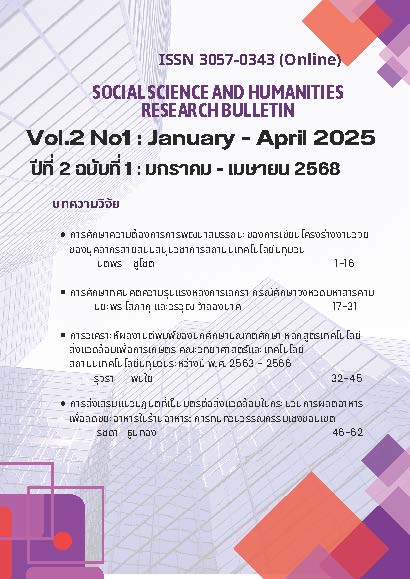
Promoting Green Practices in the Food Production Process to Reduce Food Waste in Restaurants: A Scoping Review
Keywords:
Green practices, food production process, promoting food waste reduction in restaurants, Scoping ReviewAbstract
This research aims to promote the adoption of environmentally friendly practices in the food production process to reduce food waste in restaurants. By exploring strategies to minimize waste and enhance resource efficiency in the food industry, the study addresses the dual challenges of environmental impact and resource loss posed by food waste. This research specifically examines how green practices can effectively reduce food waste, shows key obstacles and supportive factors for implementation, and evaluates the economic and social impacts of waste reduction within restaurant businesses.
The research employs a scoping review method based on the frameworks of Arksey and O’Malley (2005) and the Joanna Briggs Institute (JBI, 2020). Relevant studies were selected from reputable databases, including Scopus, Web of Science, Google Scholar, and PubMed, focusing on publications from 2019 to 2024. The selected studies address topics such as food waste reduction in restaurants, food resource management, and environmentally friendly practices.
The findings reveal actionable strategies such as controlling raw materials from procurement to preparation, using inventory management technologies, and fostering environmentally responsible behaviors at both individual and organizational levels. These approaches have proven effective in reducing food waste and are adaptable to various restaurant contexts. Furthermore, employee training and collaboration with supply chains appeared as critical factors for achieving sustainable outcomes. The study concludes that integrating environmentally friendly practices into food production processes is a workable and impactful measure for controlling food waste. Clear policy frameworks and effective monitoring systems, combined with technological integration and staff skill development, can significantly reduce food waste while promoting long-term sustainability in the food industry.
References
Arksey, H., & O’Malley, L. (2005). Scoping studies: Towards a methodological framework. International Journal of Social Research Methodology, 8(1), 19–32. https://doi.org/10.1080/1364557032000119616.
Aschemann‐Witzel, J., & Zielke, S. (2017). Can't Buy Me Green? A Review of Consumer Perceptions of and Behavior toward the Price of Organic Food. Journal of Consumer Affairs, 51, 211-251.
Aschemann-Witzel, J., de Hooge, I., Amani, P., Bech-Larsen, T., & Oostindjer, M. (2015). Consumer-related food waste: Causes and potential for action. Sustainability, 7(6), 6457-6477.
Beretta, C., Stoessel, F., Baier, U., & Hellweg, S. (2013). Quantifying food losses and the potential for reduction in Switzerland. Waste Management, 33(3), 764–773.
Beretta, V., Demartini, C., & Trucco, S. (2019). Does environmental, social and governance performance influence intellectual capital disclosure tone in integrated reporting? Journal of Intellectual Capital, 20(1), 100–124.
Burgess, K. & O’Neill, M. (2020). The Role of Technology in Reducing Food Waste: The Case of Restaurants. Waste Management, 105, 200-211.
Betz, A., Buchli, J., Göbel, C., & Müller, C. (2015). Food waste in the Swiss food service industry—Potential for reduction. Waste Management, 46, 632–641. https://doi.org/10.1016/j.wasman.2015.08.027.
Chaiyaporn, C. (2020). Waste Management Practices in Thai Restaurants: Case Study of Mango Tree. Asian Journal of Hospitality and Tourism, 9(1), 56-70.
Chen, Y. S. (2008). The Driver of Green Innovation and Green Image – Green Core Competence. Journal of Business Ethics, 81(3), 531-543.
Choudhury, T., & Rahman, M. (2022). Sustainable food waste management practices: Exploring the roles of consumers and restaurants. Journal of Environmental Management, 305, 114331.
Ellen MacArthur Foundation. (2013). Towards the circular economy: Economic and business rationale for an accelerated transition. Ellen MacArthur Foundation. Retrieved from Transitioning to a circular economy business | Report.
Eze, U. C., & Paul, A. (2023). Green consumer behavior in emerging markets: Implications for sustainability in the food service industry. Sustainable Development Research and Practice in Asia, 12(3), 15–29.
Filimonau, V., Matute, J., Kubal-Czerwińska, M., Krzesiwo, K., & Mika, M. (2020). The determinants of consumer engagement in restaurant food waste mitigation in Poland: An exploratory study. Journal of Cleaner Production, 247, 119105.
Food and Agriculture Organization of the United Nations (FAO). (2019). The State of Food and Agriculture: Moving forward on food loss and waste reduction. FAO.
Food and Agriculture Organization of the United Nations. (2021). Promoting sustainable food systems. Retrieved from https://www.fao.org.
Food Management Association (FMA). (2021). Food Waste Reduction Strategies in Restaurants. Retrieved from
https://www.foodmanagementassociation.org/food-waste-reduction.
Garcia, M. (2020). Partnerships in food waste management. Journal of Sustainable Development, 15(2), 123-140.
Garrone, P., Melacini, M., & Perego, A. (2014). Managing food waste in the food service industry: A case study. Waste Management, 34(4), 748-758. https://doi.org/10.1016/j.wasman.2013.10.019.
Geissdoerfer, M., et.al. (2017). The Circular Economy – A new sustainability paradigm? Journal of Cleaner Production, 143, 757-768.
Göbel, C., et.al. (2015). Cutting Food Waste through Cooperation along the Food Supply Chain. Sustainability, 7(2), 1429-1445.
Graves, L. M., & Sarkis, J. (2016). Employee Engagement in Green Behavior. Journal of Organizational Behavior, 37(3), 324-341.
Griffin, M., Sobal, J., & Lyson, T. (2018). An analysis of food waste in full-service restaurants. International Journal of Hospitality Management, 31(3), 717-726.
Gruber, J., et.al. (2020). Mental health and clinical psychological science in the time of COVID-19: Challenges, opportunities, and a call to action. American Psychologist. Advance online publication.
Gunders, D. (2012). Wasted: How America Is Losing Up to 40 Percent of Its Food from Farm to Fork to Landfill. Natural Resources Defense Council.
Gustavsson, J., et.al. (2011). Global food losses and food waste: Extent, causes and prevention. Food and Agriculture Organization of the United Nations (FAO). Retrieved from https://www.semanticscholar.org/
Jones, D., & Thompson, R. (2022). Eco-friendly strategies for food production. Food Science Review, 12(2), 75-90.
Jones, P., & Robinson, P. (2012). Operations management. Oxford University Press.
Kummu, M., et.al. (2012). Lost Food, Wasted Resources: Global Food Supply Chain Losses and Their Impacts on Freshwater, Cropland, and Fertilizer Use. Science of the Total Environment, 438, 477-489.
Lee, K., & Kim, H. (2020). Employee training and its impact on food waste management. Food and Beverage Management Review, 12(2), 102-116.
Lohman, L., Kulshreshtha, S., & Striegler, R. (2019). Food waste and its relation to energy usage in the United States. Agriculture and Human Values, 36(1), 59-75.
Luo, X., & Bhattacharya, C. B. (2006). Consumer Responses to Green Initiatives. Journal of Marketing Research, 43(4), 88-101.
Martins, J. (2023). The role of technology in reducing food waste. Journal of Food Technology, 8(1), 45-60.
Mena, C., Adenso-Diaz, B., & Yurt, O. (2014). The role of food waste management in sustainable restaurant operations. Waste Management, 34(5), 794-804.
Mourad, M. (2016). Recycling, recovering and preventing "food waste": Competing solutions for food systems sustainability in the United States and France. Journal of Cleaner Production, 126, 461-477.
Nagasharmila, P., et.al. (2023). A Holistic Approach to Food Waste Management: Leveraging Full-Stack Technologies for Efficient Resource Utilization. 2023 Third International Conference on Smart Technologies, Communication and Robotics (STCR), 1, 1-5.
Ottman, J. A. (2011). The New Rules of Green Marketing: Strategies, Tools, and Inspiration for Sustainable Branding. Greenleaf Publishing.
Papargyropoulou, E., et.al. (2014). The food waste hierarchy as a framework for the management of food surplus and food waste. Journal of Cleaner Production, 76, 106–115.
Parfitt, J., Barthel, M., & Macnaughton, S. (2010). Food waste within food supply chains: Quantification and potential for change to 2050. Waste Management, 31(1), 11-20.
Rahman, A. (2021). Corporate responsibility and food waste reduction. Business Ethics Journal, 9(4), 200-215.
Rattanasak, S. (2020). Zero Waste Initiative in Thai Restaurants: A case study of "Eat Well" restaurant. Journal of Sustainable Food Systems, 12(1), 22-29.
ReFED. (2021). Insights Engine and Roadmap to 2030: Reducing U.S. Food Waste by 50%. Retrieved from https://refed.org/food-waste/the-solutions.
Ritchie, H., Roser, M., & Mispy, J. (2021). Reducing food waste: The impact of sustainable practices in the food service industry. Food Policy, 98, 101984.
Sahoo, A., et.al. (2023). Insights into the management of food waste in developing countries: with special reference to India. Environmental Science and Pollution Research International, 1 - 27.
Santos, M. (2021). Impact of quality monitoring technologies in food waste reduction. International Journal of Food Science & Technology, 36(4), 654-667.
Schaltegger, S., & Burritt, R. (2010). Sustainability Accounting for Companies: Ecological Efficiency as a Performance Indicator. Ecological Economics, 70(1), 90-98.
Schanes, K., Dobernig, K., & Gözet, B. (2018). Food waste matters—A systematic review of household food waste practices and their policy implications. Resources, Conservation and Recycling, 136, 88-98.
Smith, L., Brown, H., & Taylor, P. (2021). Sustainable food systems in the hospitality industry. Green Journal, 10(3), 150-165.
Srivastava, S. K. (2007). Green Supply-Chain Management: A State-of-the-Art Literature Review. International Journal of Management Reviews, 9(1), 53-80.
Sukkhaphat, P. (2022). “Promoting green practices in Thai restaurants: Insights from Sustainable Food Network Thailand". Journal of Environmental Management, 12(3), 78-92.
Sutthirak, W. (2021). A comparative study of food waste management practices in Bangkok restaurants. International Journal of Food Studies, 10(1), 11-24.
Thamjinda, K. (2023). Reducing food waste through consumer awareness: A study of Thai restaurants. Asian Journal of Sustainability and Social Responsibility, 8(1), 102-115.
The Joanna Briggs Institute Critical Appraisal tools for use in JBI Systematic Reviews: Checklist for Analytical Cross-Sectional Studies. Adelaide, South Australia: Joanna Briggs Institute. Retrieved from https://www.academia.edu/49208033.
Thi, N. B. D., Kumar, G., & Lin, C.-Y. (2015). An overview of food waste management in developing countries: Current status and future perspective. Waste Management, 44, 2-12.
United Nations Environment Programme. (2020). Reducing food waste: A guide for the food industry. Retrieved from https://www.unep.org.
Wangwong, A. (2019). Sustainable restaurant practices in Thailand: A study of best practices in the food service industry. Thai Journal of Hospitality and Tourism, 14(2), 35-50.
Warde, A. (2019). Consumption and the practice of eating: Dynamics and sustainability. Journal of Consumer Culture, 19(1), 3–23.
WRAP. (2020). Reducing Food Waste through Better Systems in the Food Industry.
Yan, S., & Wang, Z. (2012). Green Practice as a Business Strategy. Journal of Environmental Management, 103, 199-207.
Zhao, Y., Zhou, H., & Xue, F. (2023). Sustainable restaurant operations: A review of current practices and future research directions. Sustainability, 15(3), 656.
Zhang, X., Cao, Q., & Zhang, Q. (2013). Corporate Social Responsibility and Green Practices. International Journal of Environmental Sustainability, 2(3), 45-52.
Zhu, Q., Geng, Y., & Lai, K. H. (2008). Environmental Supply Chain Cooperation and Its Impact on Performance: An Empirical Study in China. Supply Chain Management: An International Journal, 13(2), 116-126.