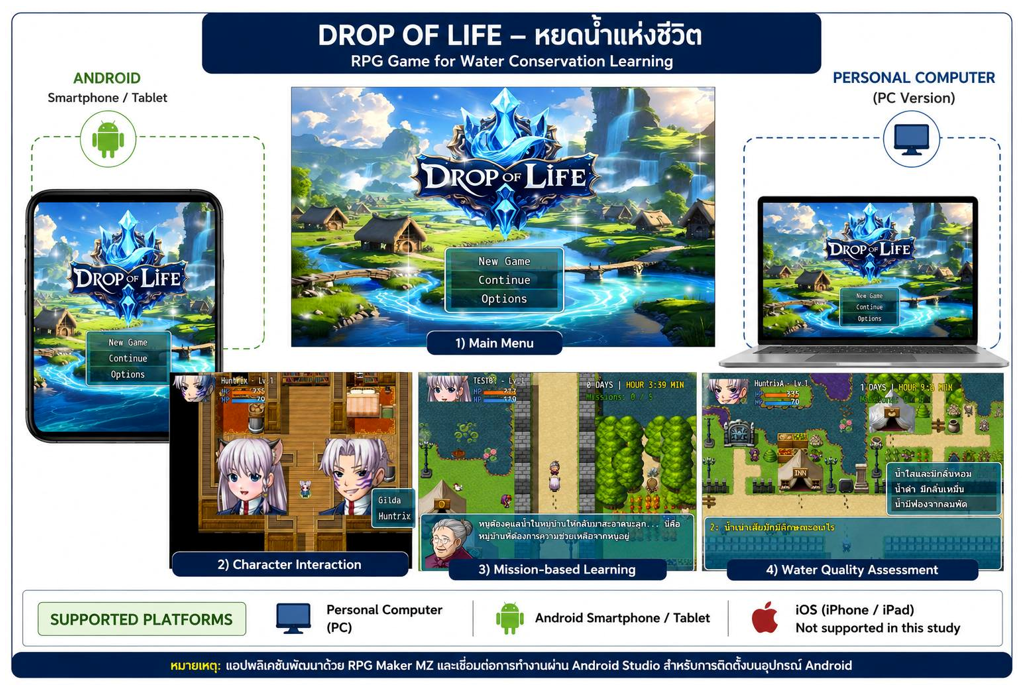
การพัฒนาเกมการเรียนรู้เพื่อส่งเสริมความรู้และความตั้งใจเชิงพฤติกรรมการอนุรักษ์ทรัพยากรน้ำของเยาวชนผ่านแอปพลิเคชัน “หยดน้ำแห่งชีวิต”
DOI:
https://doi.org/10.66854/ijdte.2026.e3880คำสำคัญ:
การเรียนรู้โดยใช้เกมเป็นฐาน, เกมสวมบทบาท, การอนุรักษ์ทรัพยากรน้ำ, SDG 6, เยาวชนบทคัดย่อ
บทนำ: การวิจัยนี้มีวัตถุประสงค์เพื่อ 1) พัฒนาแอปพลิเคชันเกมสวมบทบาทที่เสริมความรู้ด้านการอนุรักษ์ทรัพยากรน้ำของเยาวชนให้สอดคล้องกับเป้าหมายการพัฒนาที่ยั่งยืนข้อที่ 6 (SDG 6: น้ำสะอาดและการสุขาภิบาล) 2) ออกแบบระบบเกมที่จำลองสถานการณ์ปัญหาและการจัดการทรัพยากรน้ำในรูปแบบเชิงปฏิสัมพันธ์ที่เข้าใจง่ายและใกล้เคียงกับบริบทจริง และ 3) ประเมินผลของแอปพลิเคชันเกมที่พัฒนาขึ้นต่อความรู้ ความตระหนักรู้ ทัศนคติ และความตั้งใจเชิงพฤติกรรมด้านการอนุรักษ์ทรัพยากรน้ำของเยาวชน โดยพัฒนาเกมแนวสวมบทบาท ชื่อ “หยดน้ำแห่งชีวิต” ด้วยโปรแกรม RPG Maker MZ และ Android Studio เพื่อจำลองสถานการณ์ปัญหาทรัพยากรน้ำในบริบทเชิงโต้ตอบ
วิธีดำเนินงานวิจัย: การวิจัยใช้รูปแบบการทดลองก่อน–หลังกับกลุ่มตัวอย่างนักเรียนระดับมัธยมศึกษาจำนวน 38 คน โดยใช้วิธีการเลือกแบบเจาะจง เครื่องมือที่ใช้ในการวิจัย ได้แก่ แบบประเมินผลการเรียนรู้และความพึงพอใจ สถิติที่ใช้ในการวิเคราะห์ข้อมูล ได้แก่ ค่าเฉลี่ย และส่วนเบี่ยงเบนมาตรฐาน
ผลการวิจัย: ผลการวิจัยพบว่า คะแนนหลังการทดลองสูงกว่าก่อนการทดลองอย่างมีนัยสำคัญทางสถิติ (p < .001) โดยมีค่าเฉลี่ยเพิ่มขึ้นร้อยละ 41.9 และมีขนาดอิทธิพลในระดับสูงมาก ผลลัพธ์ดังกล่าวชี้ให้เห็นว่าเกมสามารถส่งเสริมผลลัพธ์การเรียนรู้ด้านความรู้ ความตระหนักรู้ และทัศนคติที่เกี่ยวข้องกับการอนุรักษ์ทรัพยากรน้ำโดยเชื่อมโยงจากความรู้ไปสู่ความตระหนักรู้และทัศนคติที่เอื้อต่อการอนุรักษ์ทรัพยากรน้ำ งานวิจัยนี้เสนอว่าเกมดิจิทัลเชิงปฏิสัมพันธ์สามารถทำหน้าที่เป็นเครื่องมือเชิงพฤติกรรมที่มีประสิทธิผลในการขับเคลื่อนการเรียนรู้ด้านสิ่งแวดล้อมและการเปลี่ยนแปลงเชิงทัศนคติของเยาวชน
Downloads
เอกสารอ้างอิง
Ardoin, N. M., Bowers, A. W., & Gaillard, E. (2020). Environmental Education Outcomes for Conservation: A Systematic Review. Biological Conservation, 241, 108224. https://doi.org/10.1016/j.biocon.2019.108224 DOI: https://doi.org/10.1016/j.biocon.2019.108224
Bain, R., Cronk, R., Wright, J., Yang, H., Slaymaker, T., & Bartram, J. (2014). Fecal Contamination of Drinking-Water in Low- and Middle-Income Countries: A Systematic Review and Meta-Analysis. PLoS Medicine, 11(5), e1001644. https://doi.org/10.1371/journal.pmed.1001644 DOI: https://doi.org/10.1371/journal.pmed.1001644
Bain, R., Johnston, R., & Slaymaker, T. (2020). Drinking Water Quality and the SDGs. NPJ Clean Water, 3(1), 37. https://doi.org/10.1038/s41545-020-00085-z DOI: https://doi.org/10.1038/s41545-020-00085-z
Bandura, A. (1986). Social Foundations of Thought and Action: A Social Cognitive Theory. Prentice-Hall.
Bilancini, E., Boncinelli, L., & Di Paolo, R. (2023). Game-Based Education Promotes Practices Supporting Sustainable Water Use. Ecological Economics, 208, 107801. https://doi.org/10.1016/j.ecolecon.2023.107801 DOI: https://doi.org/10.1016/j.ecolecon.2023.107801
Bopp, M. (2006). Didactic Analysis of Digital Games and Game-Based Learning. In M. Pivec (Ed.), Affective and Emotional Aspects of Human-Computer Interaction (8–37). IOS Press.
Connolly, T. M., Boyle, E. A., MacArthur, E., Hainey, T., & Boyle, J. M. (2012). A Systematic Literature Review of Empirical Evidence on Computer Games and Serious Games. Computers & Education, 59(2), 661–686. https://doi.org/10.1016/j.compedu.2012.03.004 DOI: https://doi.org/10.1016/j.compedu.2012.03.004
Deci, E. L., & Ryan, R. M. (2000). The “What” and “Why” of Goal Pursuits: Human Needs and the Self-Determination of Behavior. Psychological Inquiry, 11(4), 227–268. https://doi.org/10.1207/S15327965PLI1104_01 DOI: https://doi.org/10.1207/S15327965PLI1104_01
Deterding, S., Dixon, D., Khaled, R., & Nacke, L. (2011, September 28–30). From Game Design Elements to Gamefulness: Defining “Gamification”. The 15th International Academic MindTrek Conference: Envisioning Future Media Environments, 9–15. https://doi.org/10.1145/2181037.2181040 DOI: https://doi.org/10.1145/2181037.2181040
Hamari, J., Koivisto, J., & Sarsa, H. (2014, January 6-9). Does Gamification Work? - A Literature Review of Empirical Studies on Gamification. 2014 47th Hawaii International Conference on System Sciences, 3025–3034. https://doi.org/10.1109/HICSS.2014.377 DOI: https://doi.org/10.1109/HICSS.2014.377
Kuenseang, N., Wuthiworasin, W., Chansri, E., Srianek, K., & Tongprasong, P. (2024). A Multimedia for Skill Development: Using Tenses (Tower of Tense). Rattanakosin Journal of Science and Technology, 6(1), 100–109. (In Thai)
Munyuen, C., Wuttipiyapong, P., Jairassamee, J., & Yuenying, W. (2025). The Development of Interactive Media for Educating Prasat Sikhoraphum for Grade 9 Students at Sikhoraphum District, Surin. Innovation Journal of Digital Technologies and Evolution, 2(2), 89–101. https://doi.org/10.66854/ijdte.2025.e3283 (In Thai) DOI: https://doi.org/10.66854/ijdte.2025.e3283
Piaget, J. (1972). The Psychology of the Child. Basic Books.
Plass, J. L., Homer, B. D., & Kinzer, C. K. (2015). Foundations of Game-Based Learning. Educational Psychologist, 50(4), 258–283. https://doi.org/10.1080/00461520.2015.1122533 DOI: https://doi.org/10.1080/00461520.2015.1122533
Schunk, D. H. (2012). Learning Theories: An Educational Perspective (6th ed.). Pearson.
Schunk, D. H., & DiBenedetto, M. K. (2020). Motivation and Social Cognitive Theory. Contemporary Educational Psychology, 60, 101832. https://doi.org/10.1016/j.cedpsych.2019.101832 DOI: https://doi.org/10.1016/j.cedpsych.2019.101832
Skinner, B. F. (1953). Science and Human Behavior. Macmillan.
Srisa-ard, B. (2010). Introduction to Research (8th ed.). Suweeriyasan. (In Thai)
Thorndike, E. L. (1911). Animal Intelligence: Experimental Studies. Macmillan. DOI: https://doi.org/10.5962/bhl.title.1201
Tsai, S.-K., Chuang, T.-Y., & Lin, Z.-J. (2025). Enhancing Environmental Literacy Through Digital Game-Based Learning: A Technology-Integrated Attitude Change Approach. Sustainability, 17(16), 7416. https://doi.org/10.3390/su17167416 DOI: https://doi.org/10.3390/su17167416
Tumtong, K., & Thanavuddho, S. (2025). Promoting a Buddhist Way of Life for the Conservation of the Tha Chin River of the Community in Sam Phran District, Nakhon Pathom Province. Journal of MCU Philosophy Review, 8(1), 328–341. (In Thai)
UN-Water. (2021). Summary Progress Update 2021: SDG 6—Water and Sanitation for All. United Nations.
Wouters, P., Van Nimwegen, C., Van Oostendorp, H., & Van Der Spek, E. D. (2013). A Meta-Analysis of the Cognitive and Motivational Effects of Serious Games. Journal of Educational Psychology, 105(2), 249–265. https://doi.org/10.1037/a0031311 DOI: https://doi.org/10.1037/a0031311